Setting up a water system in your van might seem complicated at first, but it’s one of the most important parts of converting a vehicle into a livable space.
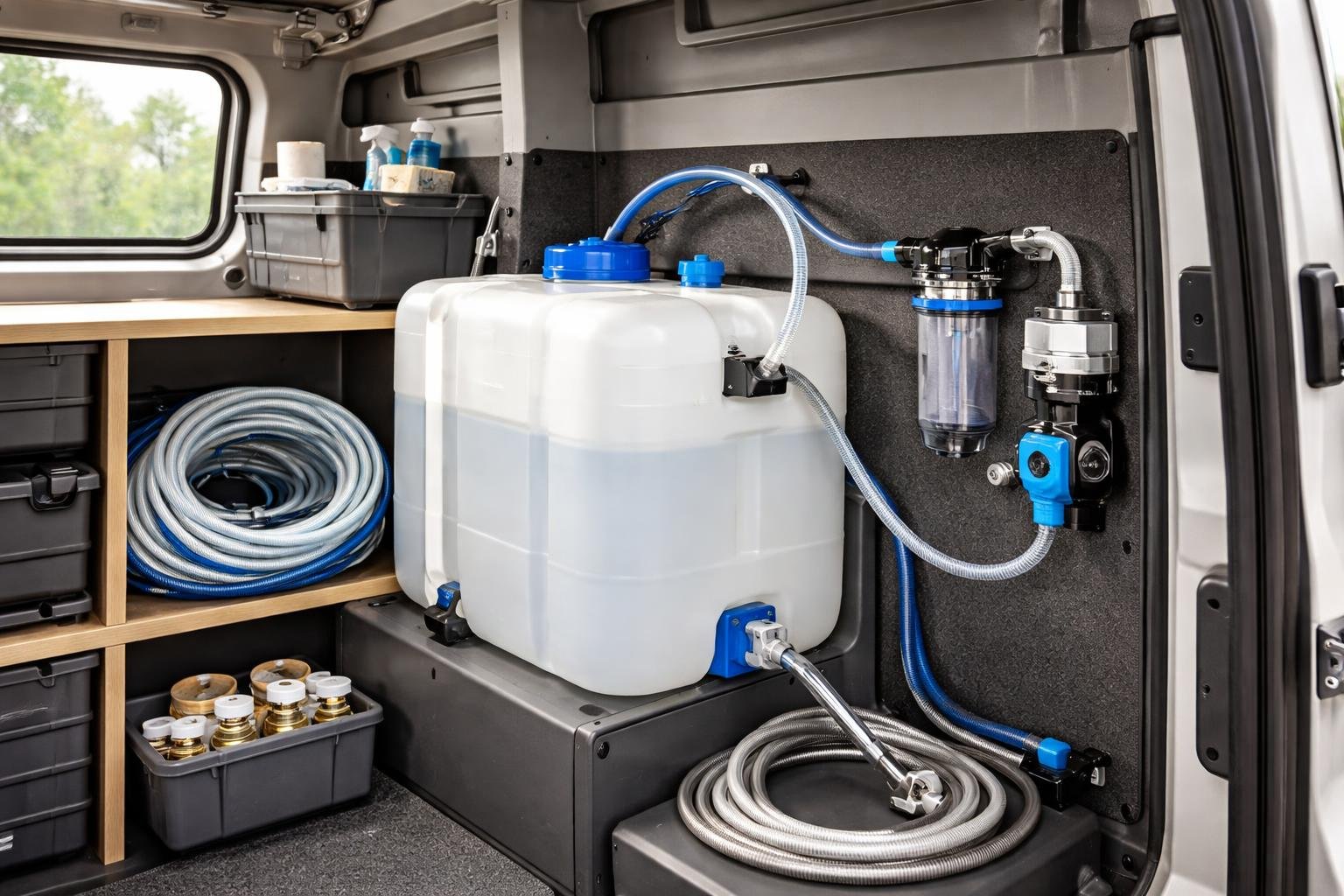
A basic van water system includes fresh water storage tanks, a pump to move water through the lines, plumbing connections to sinks or showers, and grey water tanks to collect used water.
Getting this right means you can wash dishes, take showers, and live comfortably on the road.
The good news is that designing a van’s water system is simpler than the electrical system, and you can customize it based on your needs and budget.
You might want just a basic sink setup, or you could go all out with hot water and a full shower.
Either way, understanding how the pieces work together will help you build a system that fits your lifestyle.
This guide walks you through everything from picking the right water tanks to connecting all the plumbing pieces.
You’ll learn which pumps work best, how to get hot water without taking up too much space, and what mistakes to avoid during installation.
Key Takeaways
- Van water systems need fresh water tanks, pumps, plumbing lines, fixtures, and grey water collection
- You can start with a simple sink setup and add hot water or shower components later as your budget allows
- Proper planning of tank placement and plumbing routes before installation saves time and prevents costly mistakes
How Van Life Water Systems Work
A van water system moves fresh water from a storage tank through a pump to your faucets and shower, then collects used water in a grey tank.
The setup requires only a few main parts that work together to give you running water on the road.
Key Components Explained
Your camper van water system starts with a fresh water tank that stores clean water for drinking, cooking, and washing.
You’ll need a 12V water pump to push water through your lines since gravity alone won’t create enough pressure.
An accumulator sits right after the pump to smooth out pressure spikes and prevent your water from pulsing when you turn on the tap.
Points of use include your sink, shower head, and any outdoor spray attachments where water exits the system.
A grey water tank catches all the water that goes down your drains.
Ball valves let you shut off sections of your system for repairs or winterization.
You’ll also need tubing to connect everything together.
Most van builders use PEX tubing or braided vinyl lines instead of rigid copper pipes.
PEX A can handle freezing better with a 500 PSI burst rating, while PEX B costs less upfront but uses more expensive fittings.
Choosing the Right Water System Type
Your water system type depends on how much space you have and how long you stay off-grid.
A basic gravity-fed setup works for weekend trips but lacks the pressure needed for a proper shower.
Most van lifers choose a pressurized system with a 12V pump because it gives you consistent water flow at all your fixtures.
This setup requires a battery but uses very little power.
For tank sizes, multiply your daily water usage by seven days if you’re living in your van full-time, or by three days for weekend adventures.
Over-the-wheel-well tanks make the best use of space and keep heavy water weight centered over your axle.
Standard box-shaped tanks cost less but take up more usable storage room.
Your grey tank only needs to be about 60% the size of your fresh tank since not all water goes down the drain.
How Water Moves Through Your Van
Water flow starts when you flip on your 12V water pump switch.
The pump pulls water up through a pickup tube that reaches to the bottom of your fresh tank.
This pressurizes your entire plumbing system to around 40-60 PSI.
When you open a faucet, pressurized water rushes through your PEX lines to that fixture.
The accumulator keeps pressure steady so you don’t get spurts and stops.
After you use the water, it flows down through a P-trap that blocks sewer gases, then into your grey tank below.
You control the pump with a switch so your system isn’t always pressurized.
Keeping it off when not in use saves battery power and prevents leaks from building pressure.
The whole system runs on 12V power from your van’s electrical setup.
Water System Diagrams
A basic van water system diagram shows water flowing in one direction from fresh tank to grey tank.
Your fresh tank sits in the back, usually over a wheel well.
The pickup tube drops into it from the top to avoid side-mounted holes that can leak.
The pump mounts nearby on a solid surface to reduce vibration noise.
It connects to the accumulator with a short piece of tubing.
From there, your main water line runs to a manifold that splits off to each fixture.
Hot water systems add a branch that runs through a water heater before reaching your fixtures.
You’ll need separate hot and cold lines running to any tap that needs both.
Grey water plumbing stays completely separate and uses wider diameter pipes so water drains quickly without backing up.
Most diagrams show ball valves installed before and after key components so you can isolate sections for maintenance.
Place your grey tank as low as possible in your build since water needs to drain down into it by gravity.
Designing Your Campervan Water Setup
Water weighs about 8.3 pounds per gallon, so your system design needs to balance capacity with your van’s weight limits and available space.
Smart planning prevents frozen pipes in winter and keeps your water clean and safe year-round.
Understanding Your Water Usage
You need to figure out how much water you actually use each day before buying tanks.
Track your water habits for activities like showering, cooking, washing dishes, and drinking.
Most van lifers use between 5 to 7 gallons per day for two people.
Showers typically use 1 to 2 gallons with a low-flow head.
Cooking and dishes add another 2 gallons.
Drinking water accounts for about 1 to 2 gallons per person.
Keep a log for a week to see your real usage patterns.
You might find you use more water on days you cook complicated meals or less when you eat out.
This helps you pick the right water tank size for your needs.
Your grey water tank should be about 60% of your fresh water tank size since not all water goes down the drain.
A water usage audit helps you calculate exactly what tank sizes work for your lifestyle.
Planning for Weight and Space
Water weight adds up fast and affects how your van drives.
A 30-gallon tank holds 249 pounds of water plus the tank weight itself.
Put your fresh water tank over the wheel well if possible.
This centers the weight over your axle for better handling.
Over the wheel well tanks fit the curved space and leave more room for storage underneath.
Your grey water tank can be smaller and mounted under the van or in a cabinet.
Some people use 5-gallon jugs they can remove and dump easily.
Others install permanent tanks with drain valves.
Check your van’s payload capacity before picking tank sizes.
Add up everything you’ll carry including water, gear, people, and build materials.
A Ford Transit typically handles 3,000 to 4,000 pounds depending on the model.
Leave space around tanks for maintenance access.
You’ll need to reach connections and install a water gauge to monitor levels.
Plan where pipes will run between components before drilling holes.
Insulation and Winter Considerations
Frozen pipes can burst and ruin your whole water system in cold weather.
You need to protect tanks and lines when temperatures drop below 32°F.
Wrap your fresh water tank with foam board insulation at least 1 inch thick.
Use spray foam to fill gaps around the tank edges.
Your water pump and pipes need insulation too, especially any lines running along exterior walls.
Heat tape or heating pads keep water from freezing overnight.
Connect them to your electrical system with a thermostat that turns on at 35°F.
Some van lifers drain their system completely in winter instead of heating it.
Store tanks inside your insulated living space when you can.
Tanks mounted under the van freeze faster than interior ones.
If you must use an exterior tank, build an insulated box around it with ventilation to prevent condensation.
PEX A tubing handles freezing better than PEX B because it expands without bursting as easily.
But no pipe survives repeated freeze-thaw cycles, so proper insulation matters more than pipe choice.
Water System Safety and Hygiene
Clean water tanks prevent bacteria growth and keep you healthy on the road.
Sanitize your fresh water tank with bleach before first use and every few months after.
Use food-grade hoses and tanks only.
Regular garden hoses contain chemicals that leach into drinking water.
Buy hoses marked as drinking water safe from RV suppliers.
Install a water filter at your faucet or inline before your pump.
Filters remove sediment, chlorine, and some bacteria.
Replace filter cartridges based on gallons used, not just time passed.
A P-trap under your sink stops sewer gases from coming back up the drain.
This simple curved pipe holds water that blocks smells from your grey tank.
Empty grey water every few days to prevent odors.
Never dump grey water near lakes, rivers, or streams.
Find RV dump stations or dispose of it at campgrounds with proper facilities.
Use biodegradable soap to reduce environmental impact when you do empty tanks on approved land.
Add a shutoff valve before your pump so you can depressurize the system.
This prevents leaks when you’re not using water and makes repairs easier.
Keep pressure under 50 PSI to protect connections and fittings.
Choosing and Installing Water Storage Systems
Your water storage setup determines how long you can stay off-grid and how comfortable your van life experience will be.
The right combination of fresh, grey, and black water tanks depends on your available space, travel style, and whether you prioritize stealth or extended boondocking.
Fresh Water Tanks: Types and Placement
You’ll find three main options for storing fresh water in your van.
Permanently installed tanks mount inside your build or underneath the vehicle.
Portable water tanks give you flexibility to refill away from your van.
Collapsible water containers store flat when empty and expand when needed.
Permanently Installed Tanks work best for full-time van life.
You can place them inside your build, typically under benches or in cabinets.
This keeps water from freezing in cold weather.
Under-slung water tanks mount beneath your van to save interior space, but they’re more prone to freezing and need protection on rough terrain.
Tank materials matter.
Food-grade plastic tanks cost less and weigh less than metal options.
Stainless steel tanks handle bumpy roads better and last longer, making them worth the extra cost if you plan serious off-road travel.
Size and Placement depends on your build.
Many vanlifers use 20-30 gallon tanks for drinking and cooking water.
Install your tank as low as possible to keep your center of gravity stable.
Wheel well water tank designs fit between or above your wheels to maximize space.
Larger tanks need internal baffles to prevent water from sloshing while you drive.
Your tank needs four ports: a fill port for adding water, a feed line to your pump, a breather vent so air escapes during filling, and a drain valve for maintenance.
Grey and Black Water Storage Options
Your grey water tank collects wastewater from sinks and showers.
This water contains soap and food particles but no human waste.
A grey water system needs proper venting and a way to empty the tank regularly.
You have several setup options.
Some people use a portable grey water tank that sits under the sink.
Others install a valve system that lets them choose between dumping grey water immediately under the van or collecting it in a container.
A simple collapsible bucket works well for weekend trips.
Black water tanks hold toilet waste mixed with chemicals.
You’ll need to empty these at designated RV dump stations.
Many vanlifers skip black water systems entirely by using cassette toilets or composting toilets instead.
The size of your gray water tank should match your fresh water capacity.
If you have 25 gallons of fresh water, plan for at least 25 gallons of grey water storage.
Portable and Collapsible Solutions
Portable water tanks give you flexibility that fixed tanks can’t match. You can refill them at water sources far from your parking spot.
They also let you expand your water capacity when you find a great campsite and want to stay longer. Standard portable water tanks come in 5 to 7 gallon sizes with built-in handles and spigots.
Stack several of these in your van to create a modular system. Secure them with straps so they don’t shift while driving.
Collapsible water containers and water bladders pack down small when empty. A 5-gallon collapsible container takes up less space than a shoebox when not in use.
These work great as backup storage or for carrying water from distant fill locations. Water bladders can hold 10-40 gallons and conform to odd-shaped storage areas in your van.
They’re popular with overlanders who need extra capacity in remote areas.
Monitoring and Refilling Tanks
You need to know how much water you have left before you run dry in the middle of nowhere. If your tank sits in plain view, you can check it visually.
Hidden tanks need monitoring systems. Install a water level gauge with a simple button-operated display panel.
These sensors tell you exactly how many gallons remain. Better gauges show percentages from full to empty.
Mount the display somewhere you check daily, like near your bed or kitchen area. Filling Your Tanks requires the right equipment.
Use food-grade hoses rated for drinking water. Get a hose that’s wide enough to fill tanks quickly without waiting forever.
A 1.5-inch fill port with a breather hose fills much faster than smaller openings. Keep a collapsible travel hose and funnel with a built-in filter in your van.
The filter catches bugs and debris before they enter your tank. Lock your external fill port to prevent tampering when you’re parked in public areas.
Mark your refill schedule based on your water usage. Most people use 5-10 gallons per day depending on showering habits and cooking needs.
Van Plumbing: Tubing, Fittings, and Connections
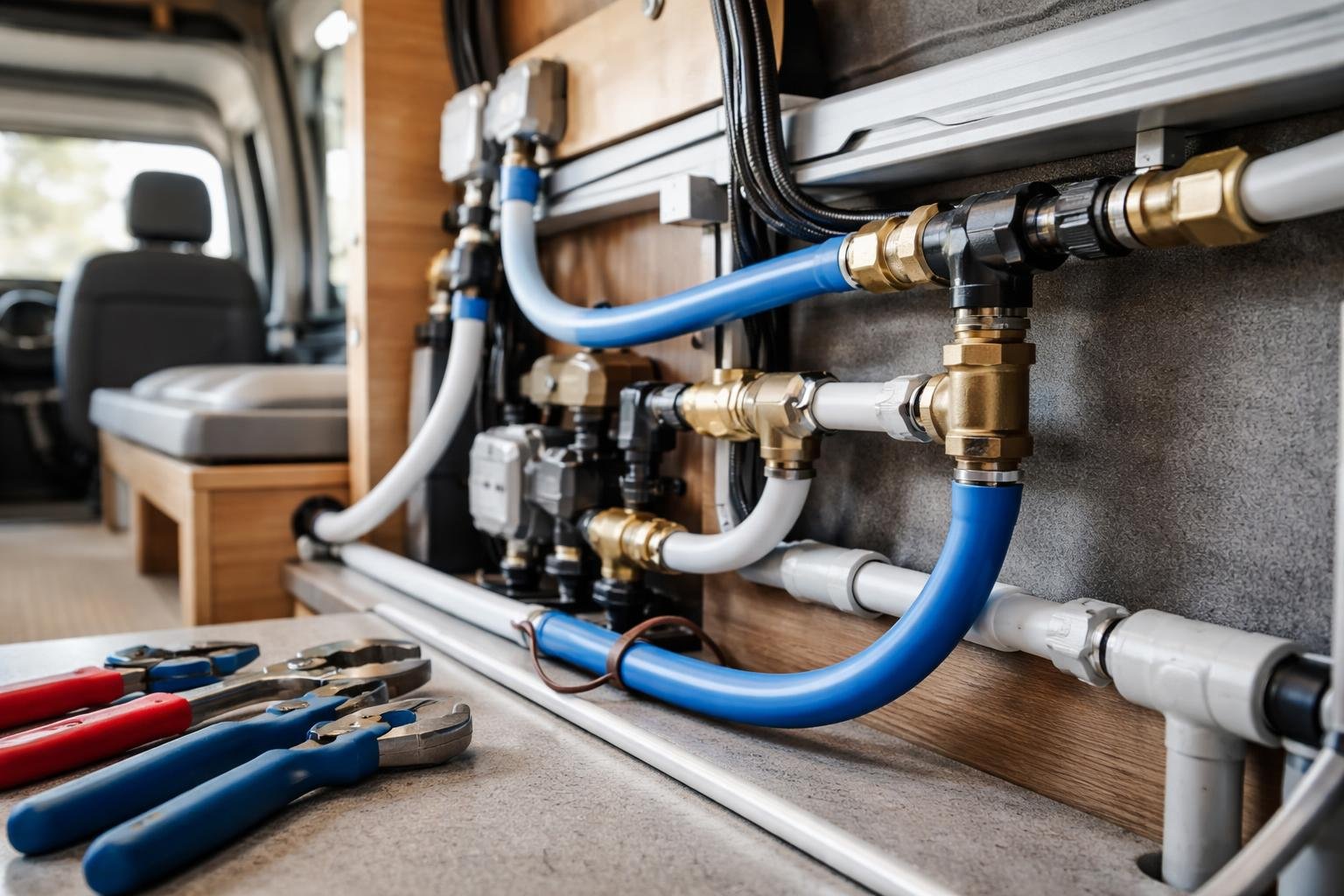
Your plumbing system connects all your water components together. The right tubing and fittings make installation easier and help prevent leaks down the road.
PEX, Braided Vinyl, and Other Tubing Options
PEX tubing is the most popular choice for van water systems. It comes in two types: PEX-A and PEX-B.
PEX-A is more flexible and easier to work with in tight spaces, while PEX-B costs less but requires more effort to bend around corners. Most vanlifers use half-inch PEX tubing for their main water lines.
This size handles good water pressure without taking up too much space. Quarter-inch tubing works fine for short runs to a single fixture.
Braided vinyl tubing is cheaper than PEX but doesn’t last as long. It can kink easily and may crack over time from UV exposure.
Some people use it for gray water drains because it’s flexible and easy to cut. You’ll want to use color-coded tubing to keep your hot and cold lines separate.
Red PEX marks your hot water lines, while blue shows cold water. This makes repairs and upgrades much simpler later on.
Push-to-Connect and Metal Fittings
Push-to-connect fittings make plumbing your van super easy. You just push the tubing into the fitting until it clicks.
No glue, no clamps, no special tools needed. These fittings work great with both PEX-A and PEX-B tubing.
PEX fittings come in different shapes for your plumbing needs. Straight connectors join two pieces of tubing.
Elbows help you turn corners. Tees let you split one line into two.
Metal fittings last longer than plastic ones but cost more. Brass fittings handle heat better if you’re running hot water lines.
SharkBite is a popular brand that makes reliable push-to-connect fittings. Always cut your tubing straight across with a proper PEX cutter.
Angled cuts won’t seal right and can cause leaks. Push the tubing all the way into the fitting until you feel it stop.
Installing a Sink and Drain
Your sink needs both a water supply and a drain system. Most van sinks like the Dometic sink come with pre-drilled holes for your faucet.
Mount the faucet before you install the sink to make the job easier. Connect your hot and cold water lines to the faucet using flexible supply hoses.
These hoses have fittings already attached that screw onto the faucet threads. Hand-tighten them first, then use a wrench for another quarter turn.
The sink drain connects to your gray water tank. Use a standard sink drain kit with a P-trap if you want to reduce odors.
The P-trap holds water that blocks smells from coming back up through the drain. Seal around your sink with marine-grade silicone caulk.
This keeps water from leaking into your cabinets or walls. Let the caulk cure for 24 hours before using your sink.
Shut-Off Valves and Leak Prevention
Shut-off valves let you turn off water to specific fixtures without draining your whole system. Install one on both the hot and cold lines going to each fixture.
Put a main shut-off valve right after your water pump. This lets you stop all water flow quickly if you spring a leak.
You can also turn it off when you’re not using the van to prevent accidental flooding. Proper sealing and shutoffs protect your van from water damage.
Check all your connections for leaks before you close up walls or cabinets. Run water through the system and look for drips.
Use thread seal tape on any threaded connections. Wrap it clockwise around the threads three to five times.
This creates a watertight seal that prevents slow leaks. Add drain points at the lowest spots in your system.
These let you empty all the water before winter storage or when you’re not using the van for a while.
Pump Systems and Water Pressure Devices
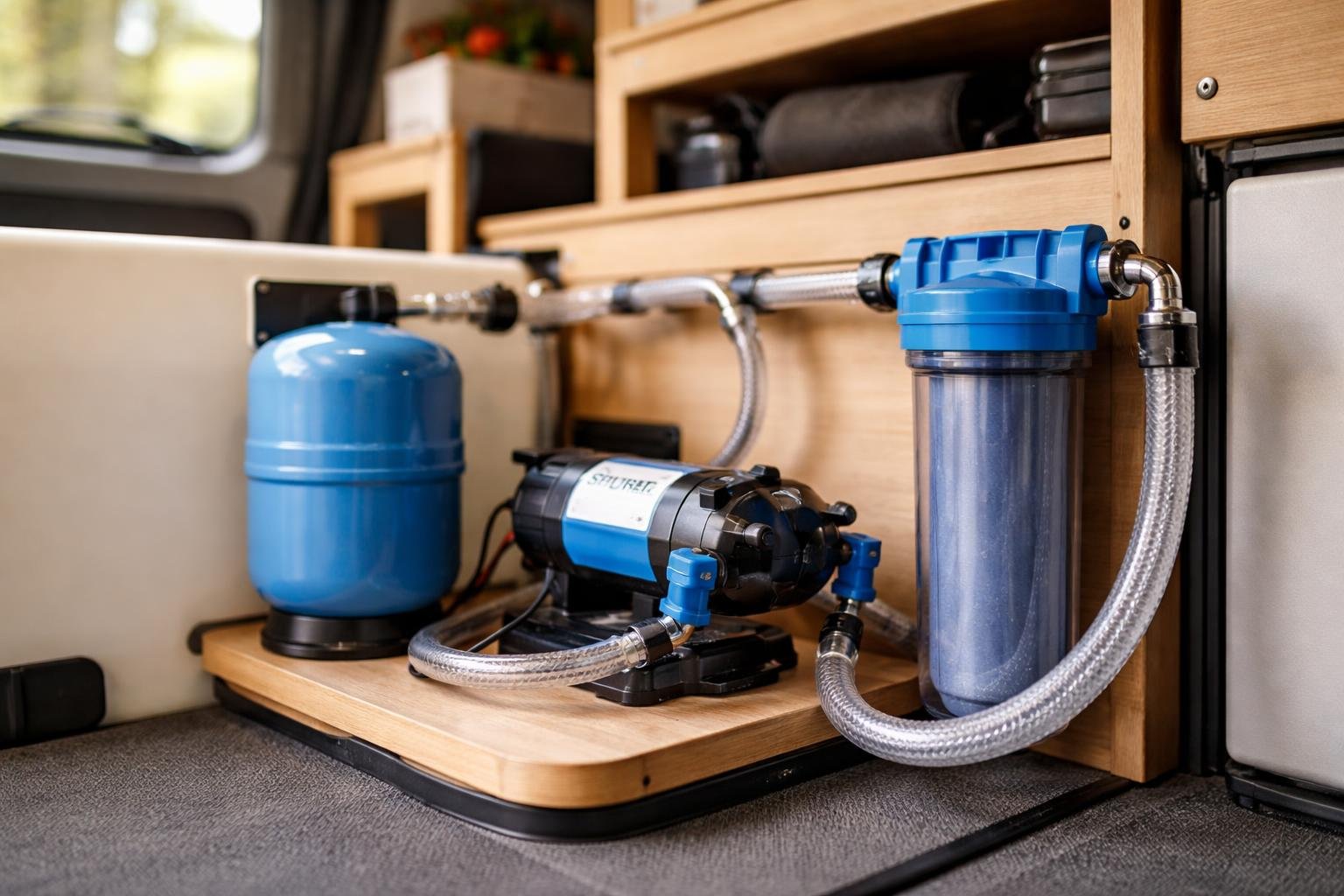
Your van’s pump system moves water from storage tanks to your faucets and shower. Pressure devices smooth out the flow and reduce pump cycling.
The right setup depends on your power availability, budget, and how much water pressure you need.
Electric Water Pumps: 12V and Diaphragm Types
A 12V water pump is the most common choice for van conversions because it runs off your vehicle’s electrical system. These pumps automatically turn on when you open a tap and shut off when you close it.
Diaphragm pumps are the standard type for van life. They use a flexible membrane that moves back and forth to push water through your system.
The Shurflo 4008 series delivers 45-55 PSI pressure with 11-15 liters per minute flow rates, making them strong enough for shower systems. Whale pumps operate more quietly than Shurflo models but provide lower pressure at 10-30 PSI.
If you only need to run a sink, the quieter operation might matter more to you than high pressure. Most electric water pumps draw 3-7 amps and include built-in pressure switches.
This means they detect when pressure drops and automatically restart without needing separate controls.
Manual Options: Hand and Foot Pumps
Hand pumps and foot pumps don’t require any electrical power. You physically pump a handle or press a pedal to move water through your plumbing.
A hand pump mounts directly on your sink or countertop. You push down on the pump handle to draw water up from your tank.
These work well for basic kitchen setups but require one hand to operate while you’re trying to wash dishes or fill a pot. Foot pumps install under your sink with a pedal on the floor.
You step on the pedal to pump water, leaving both hands free for washing and cooking. This makes them more practical for daily use than hand pumps.
Manual water pump systems cost $20-50 compared to $80-150 for electric pumps. They also eliminate the electrical draw and pump cycling noise that some people find annoying at night.
Pressure Accumulators Explained
An accumulator tank stores pressurized water to reduce how often your pump cycles on and off. Without one, your pump pulses every few seconds when you use a tap.
The tank contains a rubber bladder with air on one side and water on the other. When your pump runs, it fills the water side and compresses the air.
Set accumulator tank pressure 2-3 PSI below your pump cut-in pressure, typically 35-40 PSI for Shurflo pumps. You’ll need to adjust the factory pre-charge using a tire pump through the Schrader valve.
Most accumulators come set at 10-20 PSI from the factory, which is too low. Correct pressure eliminates pump pulsing and provides smooth water flow at your faucets.
Accumulator tanks range from 0.5 to 2 liters in size. A 1-liter tank works well for most van setups and costs $30-60.
Popular Pumps and Brands
Shurflo makes the most widely used campervan water pumps for DIY conversions. The 4008 model handles multiple outlets simultaneously with its 15+ liters per minute flow rate.
It costs $90-120 and lasts 3-5 years with regular use. Whale pumps like the Gulper 220 cost $70-100 and offer quieter operation with self-priming capabilities.
They work best for sink-only setups where you don’t need high pressure for showers. Flojet produces pumps similar to Shurflo with 40-60 PSI ratings.
Their Quiet Quad series reduces vibration noise, making them good for builds where sound matters more than saving $20-30. Jabsco specializes in marine-grade pumps built to handle constant vibration.
These cost $120-180 but hold up better for full-time van life over many years. Most pumps come with inlet/outlet fittings that connect to standard 12mm tubing using John Guest push-fit connectors.
Hot Water and Shower Solutions
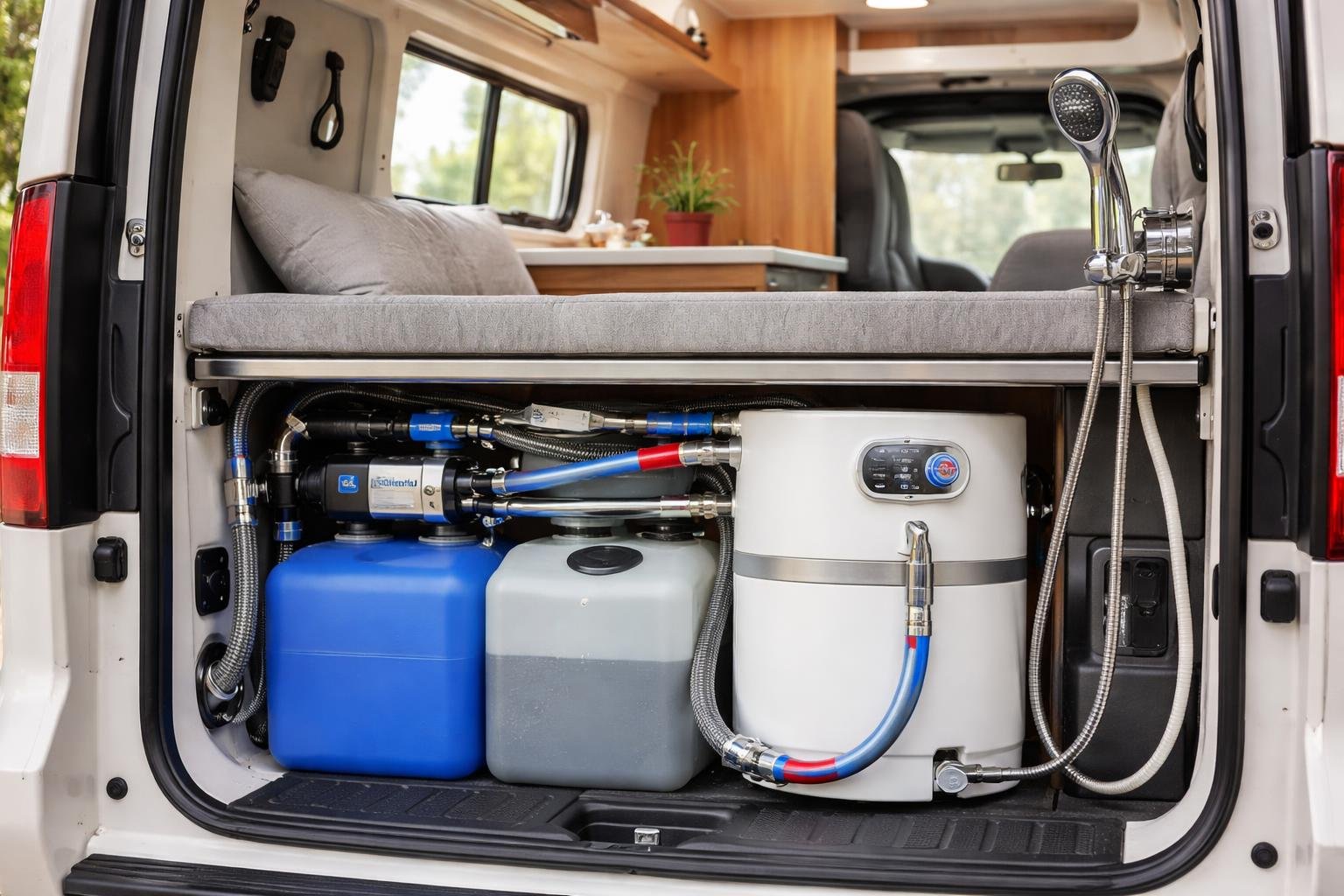
Hot water transforms van life from camping into comfortable living. You can heat water through dedicated heaters, portable systems, or integrated setups that connect directly to your plumbing.
Tankless and Tank Water Heaters
Tankless water heaters heat water on demand without storing it. The Eccotemp and Camplux are popular propane-powered options that mount inside or outside your van.
These units give you endless hot water but need good ventilation and propane supply. Tank water heaters store and heat a specific amount of water.
The Webasto Dual Top Evo heats both your van’s air and water using diesel fuel. You get 2-6 gallons of hot water ready to use whenever you need it.
Your choice depends on your space and usage. Tankless systems save space but use more power or fuel when running.
Tank heaters use fuel constantly to maintain temperature but deliver instant hot water. Most tank water heaters need 110V shore power or significant battery capacity to run electric heating elements.
Portable and Solar Shower Systems
Solar shower bags offer the simplest hot water solution. You fill a black bag with water and let the sun heat it for a few hours.
These work great for outdoor shower setups and cost under $20. Portable propane showers like battery-powered pump systems give you more control.
You heat water on your stove and pour it into an insulated container. The pump pressurizes the water so you get a real shower experience without permanent plumbing.
These systems keep water outside your van. You avoid grey water complications and save interior space.
The downside is you can’t shower in bad weather or winter conditions easily.
Integrated Hot Water Setups
Integrated hot water systems connect your water heater directly to your van’s plumbing. Your sink and shower both get hot and cold water through a mixing valve.
You need a dedicated hot water line running parallel to your cold water line. Most people use red PEX tubing for hot water and blue for cold to keep them straight.
The lines meet at each fixture with a mixing faucet or valve. This setup gives you the most convenience.
You turn a knob and adjust temperature just like at home. Installation takes more work and components but the comfort level increases significantly for full-time van life.
Proper Plumbing for Hot Water
Your hot water system needs different plumbing than cold water alone. Run your hot water line from the heater outlet to each fixture that needs hot water.
Install shut-off valves before and after your water heater for maintenance. PEX-A tubing handles heat better than PEX-B because it has a higher burst pressure rating at 500 PSI.
Use brass fittings rated for hot water applications. Standard plastic fittings can warp or fail under heat.
Add a pressure relief valve to any tank water heater. This safety device prevents dangerous pressure buildup.
Your hot water line should also have an expansion tank or accumulator to handle thermal expansion as water heats up. Insulate your hot water pipes to keep heat from escaping.
Foam pipe insulation costs a few dollars and helps your water stay hot longer between the heater and your shower.
Frequently Asked Questions
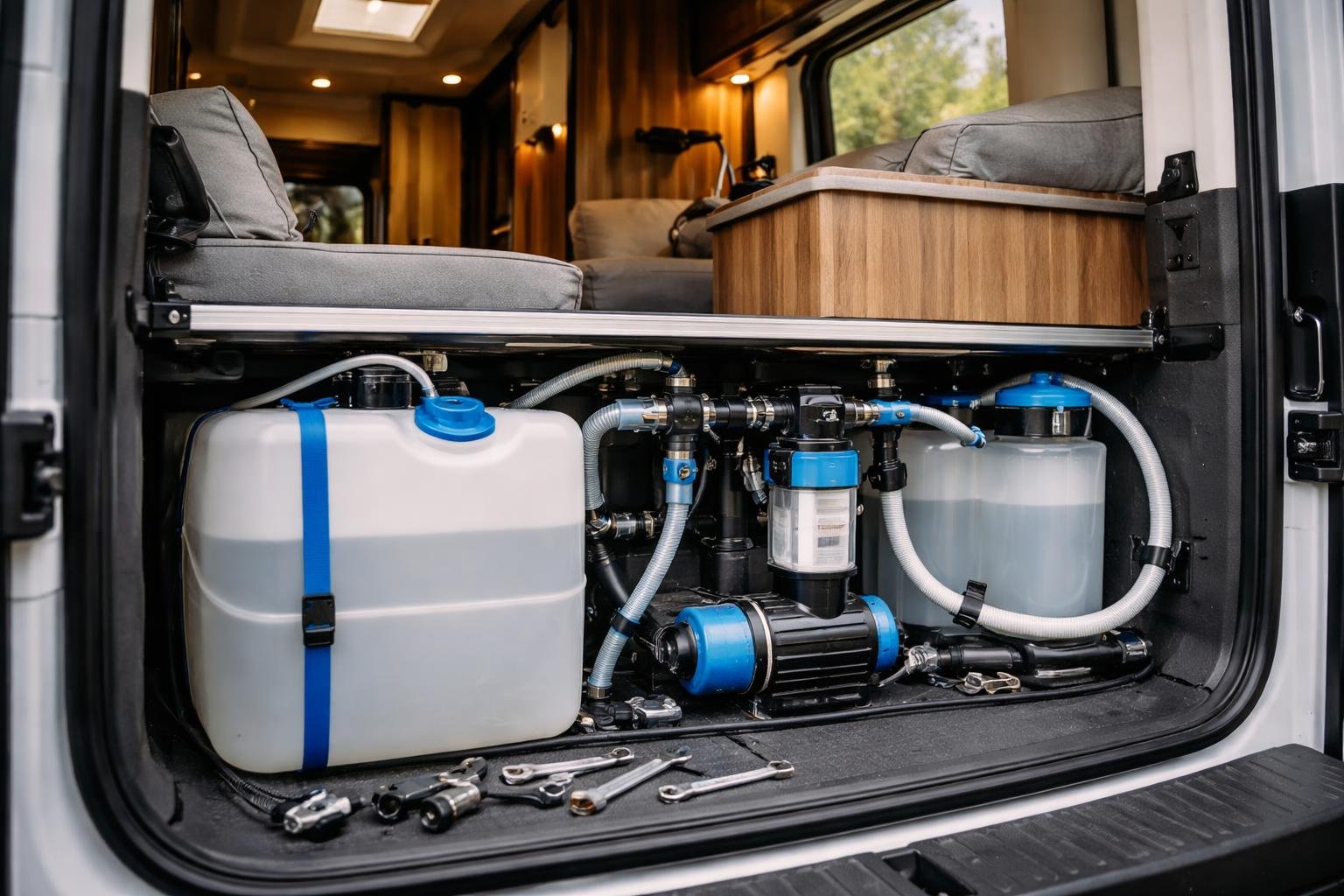
Setting up a water system involves choosing the right tank size, connecting a 12V pump with proper fittings, and understanding how to keep everything running smoothly. Many van lifers make similar mistakes during installation that can lead to leaks, frozen pipes, or wasted water.
How do you set up a water system in a campervan?
You start by installing a fresh water tank in your van, ideally over the wheel well to keep the weight balanced. Next, you’ll need to add a DIY water pickup tube through the top of the tank rather than using the pre-made holes on the sides, which helps prevent leaks.
After that, you connect a 12V water pump to pull water from your tank through the pickup tube. The pump should be on a switch so you can turn it off when not in use.
You’ll want to install an accumulator right after the pump to smooth out the water pressure. Without one, your water flow comes out uneven like a wave instead of steady.
Finally, you run your plumbing lines to your points of use like sinks and showers. PEX tubing works better than copper pipe because it’s flexible enough to navigate tight spaces in a van.
What components do I need for a simple van water system?
Your basic van water system needs seven main components. You need a fresh water tank to store your water and a grey water tank to catch used water from your sink or shower.
A 12V water pump pressurizes your system so water can flow from the tank to your faucets. An accumulator goes right after the pump to even out the pressure changes.
You’ll also need PEX tubing or braided vinyl tubing to connect everything together. Ball valves let you shut off sections of your system for repairs or maintenance.
Points of use are your actual fixtures like faucets, showers, or outdoor sprayers where you’ll use the water. Keep all these on one side of your van to make installation easier.
Can you explain the basic water system setup for a DIY campervan conversion?
Water flows from your fresh water tank through a pickup tube that sits at the bottom of the tank. The 12V pump pulls water through this tube and pushes it through your plumbing lines.
The accumulator smooths out the bumpy pressure from the pump before water reaches your faucet or shower. When you turn on a tap, water flows out until you shut it off.
Used water goes down the drain and into your grey water tank below. You can dump this grey water at RV dump sites or use a ball valve if you have an under-carriage mounted tank.
For sizing, you should do a water usage audit by tracking how much water you use daily for drinking, cooking, dishes, and washing. Multiply your daily usage by seven days if you’re full-time, or three days if you’re a weekend warrior.
What’s the best way to install a water tank and pump in my van?
Mount your fresh water tank over the wheel well if possible. This centers the heavy weight of water over your axle and uses space efficiently.
Drill a hole in the top of your tank instead of using the pre-punched holes on the sides. Install a housing with a 90-degree brass elbow and PEX tubing to create your pickup tube.
Add a 6-inch access hatch on top of your tank for cleaning and maintenance later. Mount your 12V pump near the tank but in an accessible spot for repairs.
Wire the pump to a switch so you can control when your system is pressurized. Install the accumulator directly after the pump using proper fittings.
Use ball valves throughout your system as shutoffs, especially before the pump and at each exit point.
How do I maintain a clean water supply in my van life setup?
Fill your water tank from trusted sources like campgrounds, visitor centers, or grocery stores. You can extend time between fills by carrying large water bladders that you fill at ski resorts or public facilities.
Install a UV purifying faucet if you want to treat water on demand. Keep your grey water clean by trapping food particles in your sink before they go down the drain.
Use biodegradable soaps to reduce the impact on your grey water system. Install a P-trap under your sink to capture odors from the grey tank.
Clean your fresh water tank periodically through the access hatch. Flush your system with fresh water regularly to prevent buildup or stale water taste.
What are some common mistakes to avoid when installing a water system in a campervan?
Don’t use the pre-made holes on the sides of water tanks. These become leak points that can damage your van, so drill through the top instead.
Avoid skipping the accumulator to save money. Without one, your water delivery feels choppy and the pump cycles on and off constantly, which wears it out faster.
Don’t route your plumbing across the van or up into the ceiling. This makes the pump work harder and creates more potential leak points in hard-to-reach places.
Never undersize your fresh water tank thinking you’ll conserve space. Running out of water between fill stations is miserable.
Don’t forget to install ball valves at key points in your system. Without shutoffs, a single leak means draining your entire system for repairs.
Avoid using rigid copper piping instead of flexible PEX or vinyl tubing. Copper can’t navigate the curves and tight spaces in a van, and it’s more likely to crack on rough roads.