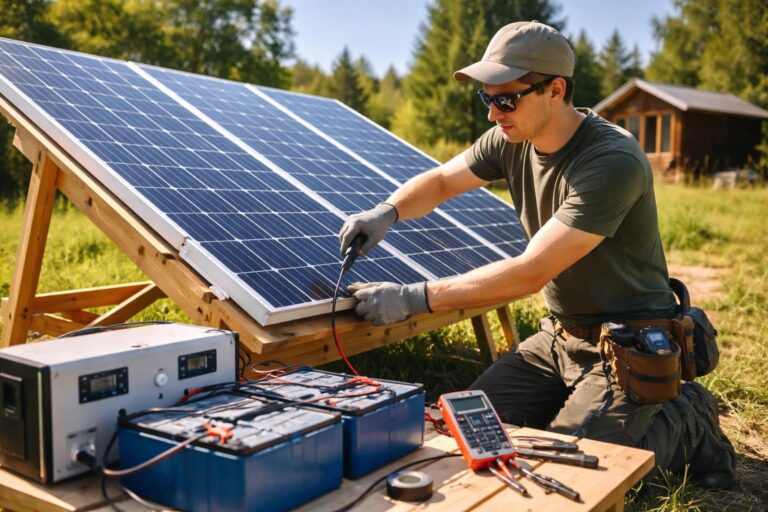
Living in a van sounds like freedom until your phone dies, your fridge stops running, and you’re stuck in the dark. A good solar setup changes everything by giving you reliable power wherever you park.
A beginner van life solar system needs four main parts: solar panels on your roof to collect sunlight, a battery to store that energy, a charge controller to manage the charging, and an inverter to run your regular electronics.
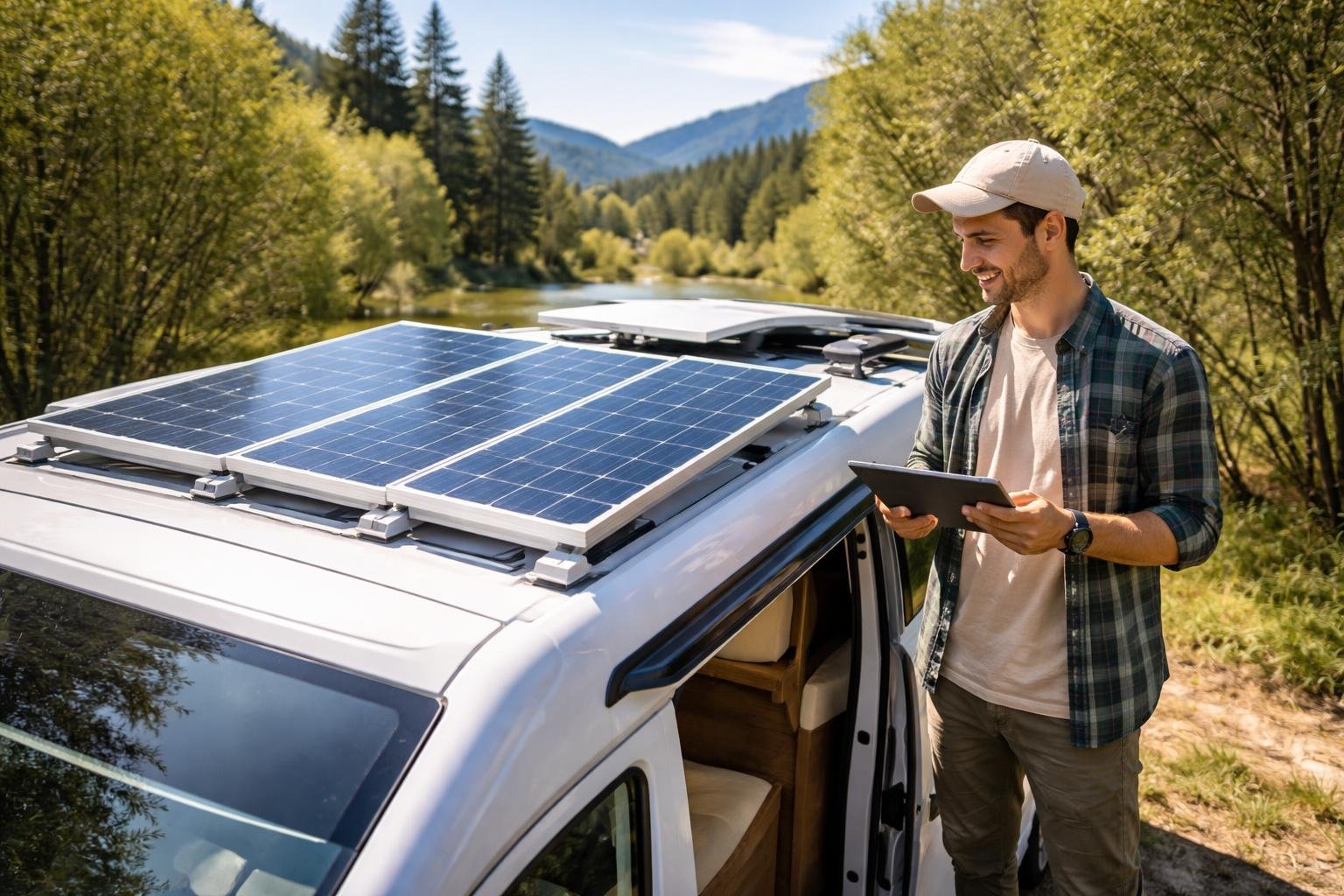
Getting your solar power setup right from the start means you won’t waste money on parts that don’t match. Most people starting out need between 200-400 watts of solar panels and a 100-200 amp hour battery.
That’s enough to run a fridge, charge your devices, and power lights without constantly worrying about running out of juice. The good news is that you don’t need to be an electrician to build a working system.
Once you understand what each piece does and how they connect together, you can create a setup that fits your budget and lifestyle. Whether you’re planning weekend trips or full-time van life, this guide walks you through everything you need to know to get started.
Key Takeaways
- A basic van solar system includes panels, a battery, a charge controller, and an inverter working together to give you off-grid power
- Most beginners need 200-400 watts of solar panels and a 100-200Ah LiFePO4 battery based on daily energy use
- Proper sizing and wiring from the start prevents costly mistakes and gives you reliable power for van life
Understanding Van Life Solar Basics
A van solar system captures sunlight on your roof, stores it in batteries, and powers your devices through controllers and inverters. This setup replaces the need for constant hookups to external power sources and gives you freedom to camp anywhere.
How a Van Solar System Works
Your camper van solar system follows a simple path from sunlight to usable electricity. Solar panels mounted on your van roof collect energy from the sun and send it to a charge controller.
The charge controller regulates the voltage and current before sending power to your battery bank. Your battery stores this energy for use day and night.
When you need to power 120V household devices like laptops or blenders, the inverter converts the 12V DC power from your battery into 120V AC power. The campervan electrical system runs constantly in a loop.
During sunny days, your panels generate electricity while simultaneously powering your devices and charging your batteries. At night or on cloudy days, your batteries supply the stored energy to keep everything running.
Essential Solar System Components
Your van life solar setup needs four main parts to function properly. Solar panels generate the electricity and typically range from 200-400W for most builds.
You’ll mount these permanently on your roof using brackets and sealant. The charge controller sits between your panels and battery to prevent overcharging.
MPPT controllers harvest 15-30% more energy than PWM models by converting excess voltage into additional current. Your battery bank stores the energy for later use.
LiFePO4 batteries work best for vans because they weigh less, last longer, and provide 80-90% usable capacity compared to just 50% from traditional AGM batteries. The inverter converts 12V battery power to 120V AC for standard household electronics.
Most van builds need 1000-2000W of pure sine wave output to safely power laptops and sensitive devices.
Energy Independence and Off-Grid Benefits
A proper van electrical system lets you camp anywhere without hookups to campground power. You can park on public lands, beach parking lots, or mountain trailheads while still running your fridge, lights, and laptop.
Solar eliminates the need for noisy generators that disturb wildlife and nearby campers. Your panels work silently and require almost no maintenance beyond occasional cleaning.
The campervan solar system pays for itself over time by cutting campground fees and fuel costs for generator running. Most van lifers spending $1000-1500 on solar avoid $30-50 nightly hookup fees and can boondock freely for years.
You gain flexibility in your travel schedule since you’re not tied to finding power sources every few days. Your battery recharges while you drive or park in sunny spots during the day.
How Much Solar and Battery Do You Need?
The right solar and battery setup depends on your actual daily power use. Most van lifers need 200-400 watts of solar panels and 100-200 amp hours of battery capacity to run basic appliances like lights, a fridge, and charge devices.
Calculating Daily Energy Consumption
You need to figure out how much power you use before buying anything. Make a list of every device you plan to run in your van and how long you’ll use it each day.
A 12V compressor fridge typically uses 50 watts and runs about 12 hours daily, which equals 600 watt-hours. LED lights might use 10 watts for 5 hours, adding 50 watt-hours.
Your laptop could draw 60 watts for 4 hours, adding 240 watt-hours. Phone charging adds about 45 watt-hours daily.
Add everything up to get your total daily energy consumption. Most beginner van builds use between 800-1500 watt-hours per day.
If you work remotely with a laptop and other devices, expect to be closer to 1200-1800 watt-hours daily. You can use a solar calculator for van conversions to help with these calculations.
Write down actual numbers for your specific devices rather than guessing.
Battery Sizing for Beginners
Your battery capacity needs to store enough power for one full day of use, plus some extra for cloudy weather. Take your daily watt-hours and divide by 12 (your system voltage), then divide by 0.9 to account for efficiency losses.
If you use 1200 watt-hours daily, you need about 111 amp hours of usable capacity (1200 ÷ 12 ÷ 0.9 = 111). A single 100Ah LiFePO4 battery gives you 80-90 usable amp hours, while a 200Ah battery provides 160-180 usable amp hours.
LiFePO4 batteries are the best choice for van life. They weigh less than traditional batteries, last 8-10 years, and you can use 80-90% of their capacity safely.
An AGM battery only lets you use 50% of its capacity before damaging it. A 200Ah battery bank covers most beginner setups comfortably and gives you nearly two days of backup power.
Get a battery monitor so you can track your actual usage and state of charge instead of guessing.
Choosing Your Solar Panel Wattage
Your solar panels need to replace all the power you use during the day. Divide your daily watt-hours by the peak sun hours in your area, then divide by 0.85 for system losses.
Using 1200 watt-hours with 5 peak sun hours: 1200 ÷ 5 ÷ 0.85 = 282 watts of solar panels. Round up to 300 watts to be safe.
You can achieve this with two 150-watt panels or one 300-watt panel on your roof. The Southwest gets about 6 peak sun hours daily, while the Pacific Northwest gets closer to 4 hours.
Your solar panel wattage for van life needs to match where you’ll be traveling most often. Most beginners do well with 200-400 watts total.
This range handles a fridge, lights, laptop charging, and basic appliances without overwhelming your roof space or budget.
Choosing and Sizing Solar Panels
Van solar panels come in different types and sizes, with most setups ranging from 100W to 400W depending on your power needs. The right choice depends on your roof space, budget, and whether you want a permanent or removable setup.
Types of Solar Panels for Vans
You’ll find two main types of solar cells used in camper van solar panels: monocrystalline and polycrystalline. Monocrystalline solar panels are the most efficient option, converting about 15-20% of sunlight into electricity.
They perform better in low light conditions and take up less roof space. Polycrystalline solar panels cost less but are also less efficient at around 13-16%.
They have a blueish color and need more space to produce the same power output. Most van builders choose monocrystalline because roof space is limited and you want maximum power from every square inch.
The efficiency difference matters when you’re trying to fit enough solar panel wattage on a van roof. A 200W monocrystalline setup takes up less room than a 200W polycrystalline system.
Rigid vs. Flexible vs. Portable Panels
Rigid solar panels are the most durable choice and last 25+ years. They sit on mounting brackets that create airflow underneath, keeping them cool and efficient.
These panels handle impacts better and are the best value per watt. Flexible solar panels bend to fit curved roofs and sit nearly flat for stealth camping.
They weigh less but only last 3-5 years and can overheat without proper airflow. You’ll pay more per watt and get less power over time.
Portable solar panels don’t require roof installation and can be angled toward the sun for maximum efficiency during peak sun hours. You can move them around to avoid shade and bring them inside at night.
The downside is setting them up daily and the theft risk. Most full-time van lifers install rigid panels permanently and add portable options later for extra power when parked in shaded spots.
Best Solar Panel Recommendations
A single 100w solar panel works for weekend trips with minimal electronics. You can charge phones, run LED lights, and power a laptop for a few hours.
This setup costs $150-300 and suits casual campers. For full-time van life, start with at least 200W of rigid monocrystalline panels.
Renogy’s 200W starter kit includes two 100W panels, a charge controller, and mounting hardware for around $400-500. This handles a 12V fridge, lights, and electronics in most conditions.
If you want flexibility without roof installation, consider a portable power station paired with foldable panels. The EcoFlow River 2 Pro with a 220W panel gives you 768Wh of storage and charges fully in about 3-4 hours of direct sunlight.
You can use it across multiple vehicles or take it hiking. Larger vans with space for 400W or more can run air conditioning, microwaves, and multiple devices.
Match your solar panel wattage to your daily energy consumption, which you can calculate using your appliances.
Wiring and Charge Controllers Explained
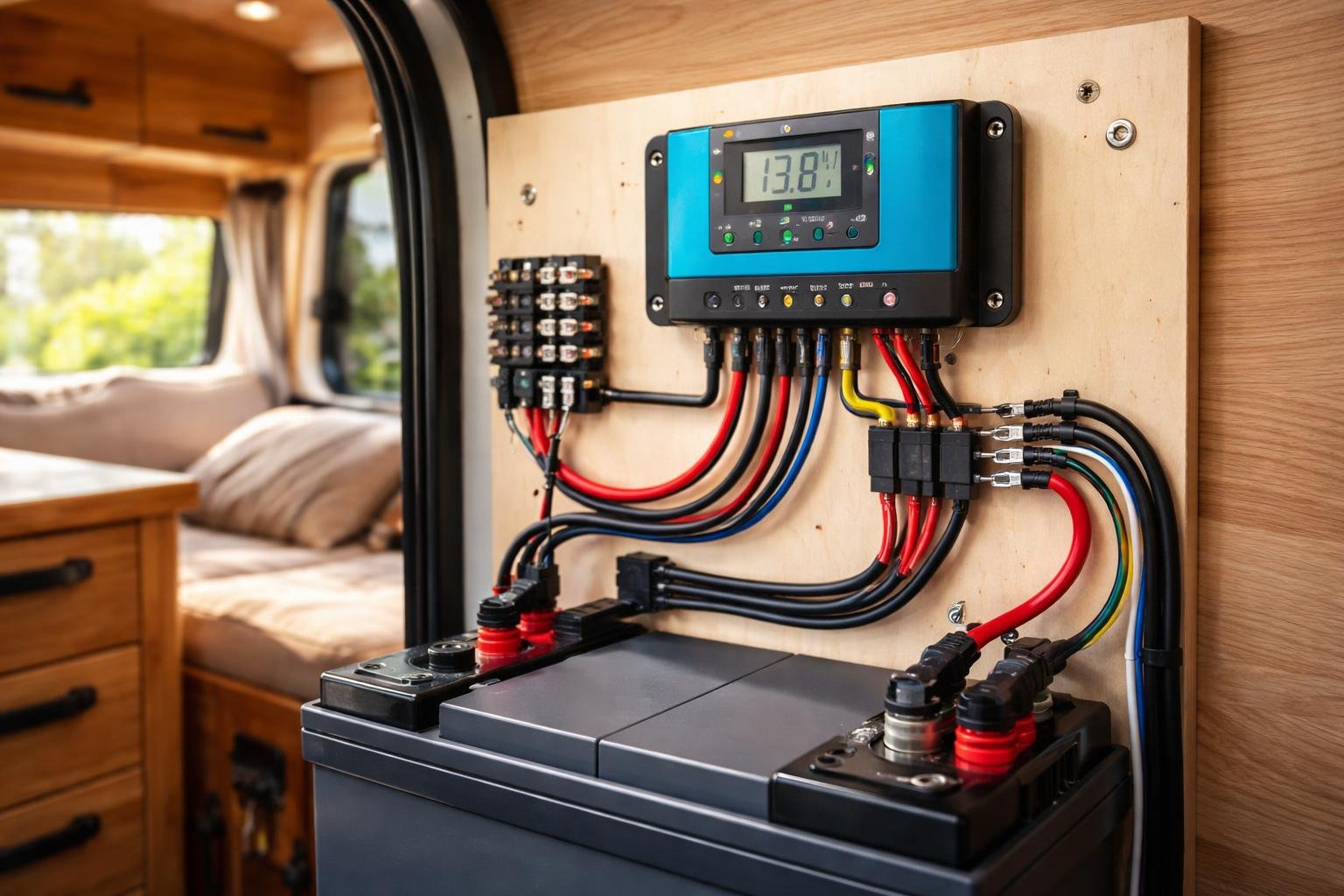
Solar panel wiring connects your panels to a charge controller that regulates power flowing into your battery. Using the right wiring method and controller type makes the difference between a system that works efficiently and one that wastes energy or creates safety hazards.
Series vs. Parallel Wiring
Series wiring connects panels end-to-end so their voltages add together while amperage stays the same. If you have two 100W panels rated at 18V and 5.5A each, wiring them in series gives you 36V at 5.5A.
Parallel wiring connects all positive leads together and all negative leads together. This adds amperage while voltage stays the same.
Those same two panels in parallel give you 18V at 11A.
Series wiring works best for van builds because higher voltage means less current, which lets you use thinner wire and reduces voltage drop over distance. Most MPPT charge controllers work more efficiently with higher input voltages too.
You need branch connectors (also called Y-connectors or MC4 branch connectors) to wire panels in parallel. For series, you just connect the positive lead of one panel to the negative lead of the next panel.
Check your panel’s maximum series fuse rating on the spec sheet before wiring in series. This tells you the maximum current your panel can safely handle if one panel gets shaded.
MPPT vs. PWM Charge Controllers
MPPT (Maximum Power Point Tracking) controllers convert excess voltage from your solar panels into additional current. This means you harvest 15-30% more energy compared to PWM controllers, especially on cold mornings when panel voltage runs high.
PWM (Pulse Width Modulation) controllers simply connect panels directly to your battery when it needs charging. They work fine if your panel voltage closely matches your battery voltage, but they waste power when there’s a voltage mismatch.
Choose MPPT for van life. The extra cost pays for itself within a year through better energy harvest.
Van roof space is limited, so you need to squeeze every watt from the panels you can fit.
For a 12V battery system with 400W of panels, you need at least a 30A MPPT controller (400W ÷ 12V = 33A). Add 20% headroom for safety and panel over-performance on cold days, so a 40A controller is better.
Make sure your MPPT solar charge controller’s maximum input voltage exceeds your panel array’s open circuit voltage (Voc). Two 200W panels in series typically produce 44-48V Voc, so a controller rated for 100V input handles this safely.
Solar Panel Wiring and Connectors
MC4 connectors are the industry standard for solar panel wiring. They’re waterproof, UV-resistant, and lock together with a click.
Your panels come with MC4 connectors already attached. You need a cable entry gland (also called a roof entry gland) to run solar cables from your roof panels into the van interior.
This creates a weatherproof seal where cables pass through the roof or wall. Mount it away from potential water pooling areas.
Use 10 AWG wire for runs up to 15 feet between panels and controller. Thinner wire creates voltage drop that wastes power and generates heat.
A wire calculator helps you size wire correctly based on current and distance. Keep wire runs as short as possible between the charge controller and battery.
Use 8 AWG wire for 30-40A controllers with runs under 6 feet. Voltage drop increases with distance and amperage.
Protecting Your System: Fuses and Breakers
Every positive wire connection needs overcurrent protection within 12 inches of the power source. This means in-line fuses or circuit breakers at your battery’s positive terminal, at your solar charge controller, and on each 12V circuit.
A main battery fuse protects against catastrophic shorts. For a 200Ah battery that can discharge at 100A, use a 150A fuse or surface breaker on the positive cable leaving the battery.
Bus bars (also called buss bars) distribute power from your battery to multiple circuits. Install a positive bus bar and negative bus bar in your electrical box.
Connect fused circuits to the positive bus bar and ground wires to the negative bus bar. Use appropriately sized fuses for each circuit.
A 5A fuse protects LED lights drawing 3A. A 10A fuse protects a fridge drawing 6A peak current.
The fuse should be rated 125% of the circuit’s maximum expected current. Surface breakers work better than fuses if you want easy reset capability.
Flip the breaker off to disconnect power instead of pulling fuses. Mount breakers in accessible locations so you can quickly kill power to any circuit.
Battery Choices and Power Storage
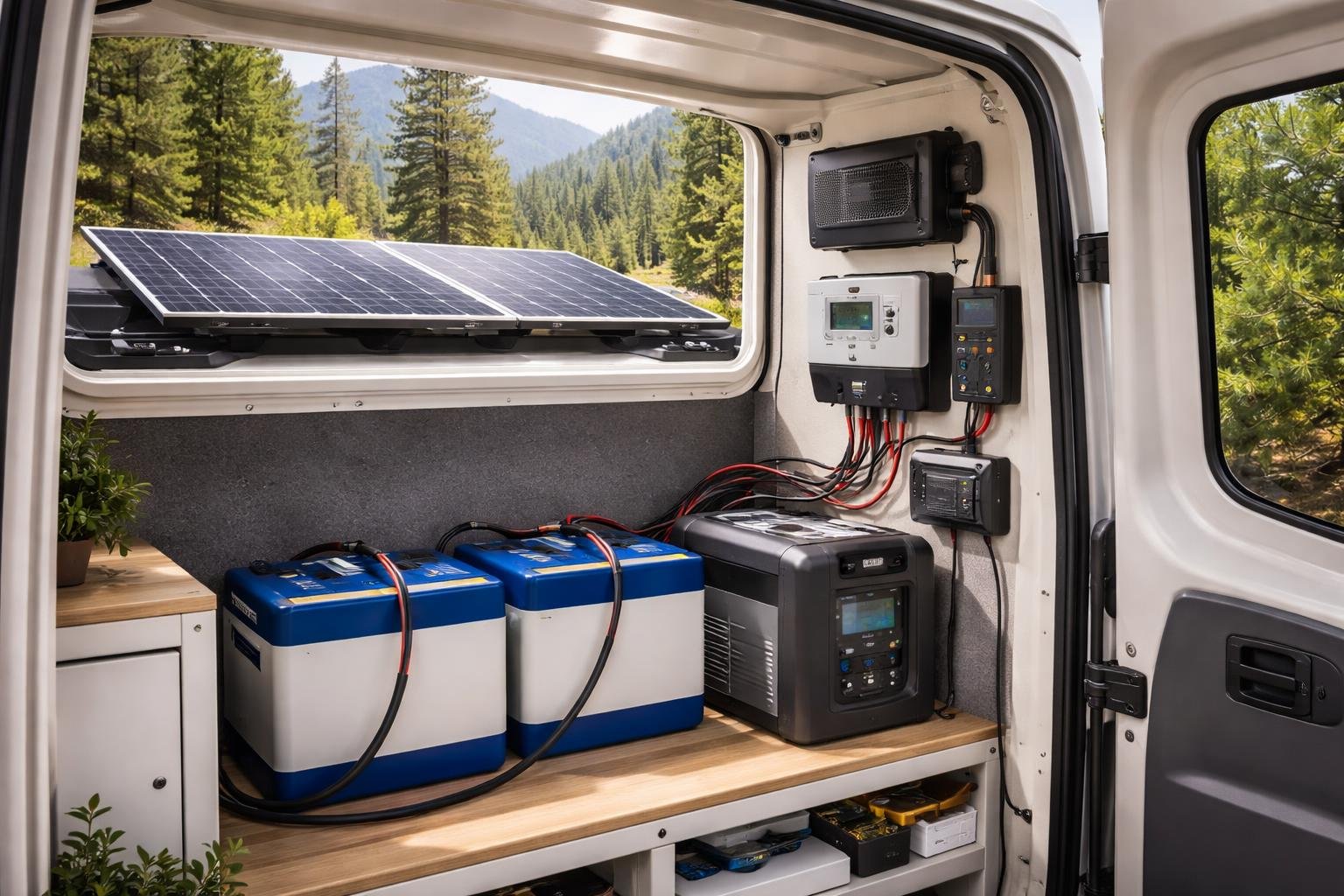
LiFePO4 batteries weigh less and last longer than traditional options, making them the top choice for most van builds despite the higher upfront cost. AGM batteries offer a budget-friendly alternative.
Battery isolators or DC-DC chargers let you charge from your alternator while driving.
Comparing Battery Types
Your 12v battery is the heart of your van’s power system. Three main types exist for van life setups.
LiFePO4 (lithium) batteries give you 80-90% usable capacity from a 100Ah battery. AGM batteries only deliver 50Ah from the same 100Ah rating because you can’t discharge them below 50% without damage.
Weight matters in a van. A 100Ah LiFePO4 battery weighs 24 pounds.
The same capacity AGM weighs 65 pounds. Lifespan is where lithium batteries shine for van conversions.
LiFePO4 batteries last 3000-5000 cycles, which equals 8-10 years of daily use. AGM batteries die after 300-500 cycles, usually within 2-3 years.
Flooded lead acid batteries are the cheapest option but require regular maintenance. You need to check water levels monthly and keep them upright to prevent spills.
Deep Dive: Lithium, AGM, and Lead Acid Batteries
LiFePO4 batteries cost $220-440 for 100Ah but deliver consistent voltage from 100% down to 10% charge. Your fridge and lights work the same at 20% as they do at full charge.
AGM batteries are sealed and maintenance-free. A 100Ah AGM costs $150-200, making them solid best campervan batteries for weekend warriors on a budget.
They handle vibration well and won’t leak if your van tips. Lead acid batteries need ventilation because they release hydrogen gas during charging.
They’re sensitive to temperature and lose capacity in cold weather. Temperature affects all batteries differently.
LiFePO4 batteries shouldn’t charge below 32°F without internal heating. AGM batteries work in freezing temps but charge slower.
Battery Performance Comparison
| Battery Type | Usable Capacity | Weight (100Ah) | Lifespan | Cost |
|---|---|---|---|---|
| LiFePO4 | 80-90% | 24 lbs | 8-10 years | $220-440 |
| AGM | 50% | 65 lbs | 2-3 years | $150-200 |
| Flooded Lead | 50% | 70 lbs | 1-2 years | $100-150 |
Battery Isolators and DC-DC Chargers
A battery isolator connects your van’s starter battery to your house battery. When your engine runs, both batteries charge.
When the engine stops, the isolator disconnects them so your house loads don’t drain your starter battery. Modern vans need a DC-DC charger instead.
Your van’s alternator produces variable voltage that can damage lithium batteries or undercharge AGM batteries. A DC-DC charger regulates voltage and current properly.
It charges your house battery at the correct rate while protecting your alternator from overload. Units like the Renogy DCC50S cost around $150.
DC-DC chargers work with solar systems too. They charge from your alternator while driving and switch to solar when parked.
This gives you power even on cloudy days. Install the DC-DC charger within 6 feet of your house battery using 6 AWG wire minimum.
Add a fuse within 12 inches of the starter battery connection.
Installing, Monitoring, and Expanding Your System
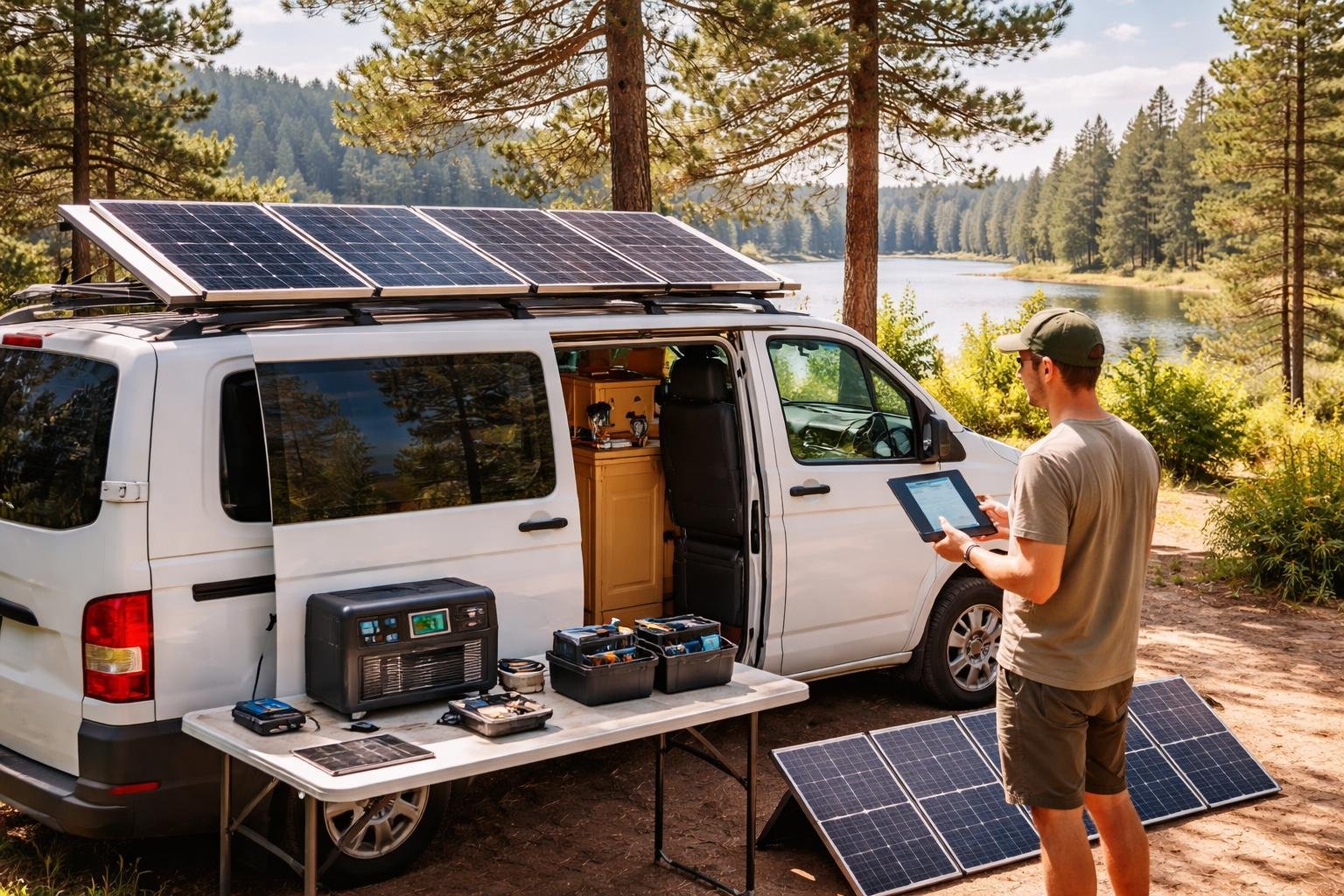
Proper installation keeps your panels secure at highway speeds. Monitoring tools show you exactly how much power you’re making and using.
Adding shore power or extra panels later gives you flexibility as your power needs grow.
Mounting Solar Panels Safely
You need to mount your panels flat on the roof using brackets or adhesive mounts. Rigid panels mounted flat are the most popular choice for full-time van life because they’re permanent and aerodynamic.
Use Z-brackets or L-brackets bolted through the roof with self-leveling lap sealant like Dicor to prevent leaks. Space the brackets 12-18 inches from each panel’s edges.
Apply sealant generously around each bolt hole before inserting the hardware, then add another layer on top. Tilt-mounted solar panels give you 30-40% more power when angled toward the sun.
But you need to lower them before driving or they’ll create wind noise and drag. Run your solar cables from the panel array through a roof entry gland.
This waterproof fitting protects the wire penetration point. Keep the cable run as short as possible to reduce voltage drop.
Use cable clips every 12 inches to secure wiring along the roof and down into your van’s interior.
Monitoring and Maintaining Your Solar Setup
A battery monitor with a shunt tells you your exact state of charge. Voltage readings alone don’t work well with LiFePO4 batteries because they hold steady voltage until nearly empty.
The Victron BMV-712 or Renogy 500A shunt monitor tracks amps going in and out to show your true battery percentage. Check your solar panel installation monthly for dirt, bird droppings, and debris.
Clean panels with water and a soft cloth. Dirty panels can lose 15-25% of their output.
Inspect mounting hardware every few months for loose bolts or cracked sealant. Retighten any loose connections and reapply sealant where you see gaps or cracks.
Check all wire connections for corrosion or heat damage, especially at the charge controller and battery terminals.
Shore Power and System Expansion Options
Shore power lets you plug into campground electrical outlets to charge your battery and run AC appliances without using your inverter. Install a 30-amp shore power inlet on your van’s exterior and connect it to a battery charger or transfer switch inside.
A DC-DC charger like the Renogy DCC50S charges your house battery from your alternator while driving. This supplements your solar panels on cloudy days and during winter months when sun is limited.
You can expand your van solar setup by adding more panels in parallel if you have roof space. Make sure your charge controller can handle the extra amperage.
Adding a second battery in parallel doubles your storage capacity without changing your system voltage. Portable folding panels work as backup power when you’re parked in shade.
Set them up in a sunny spot and run an extension cable back to your charge controller’s solar input.
Frequently Asked Questions
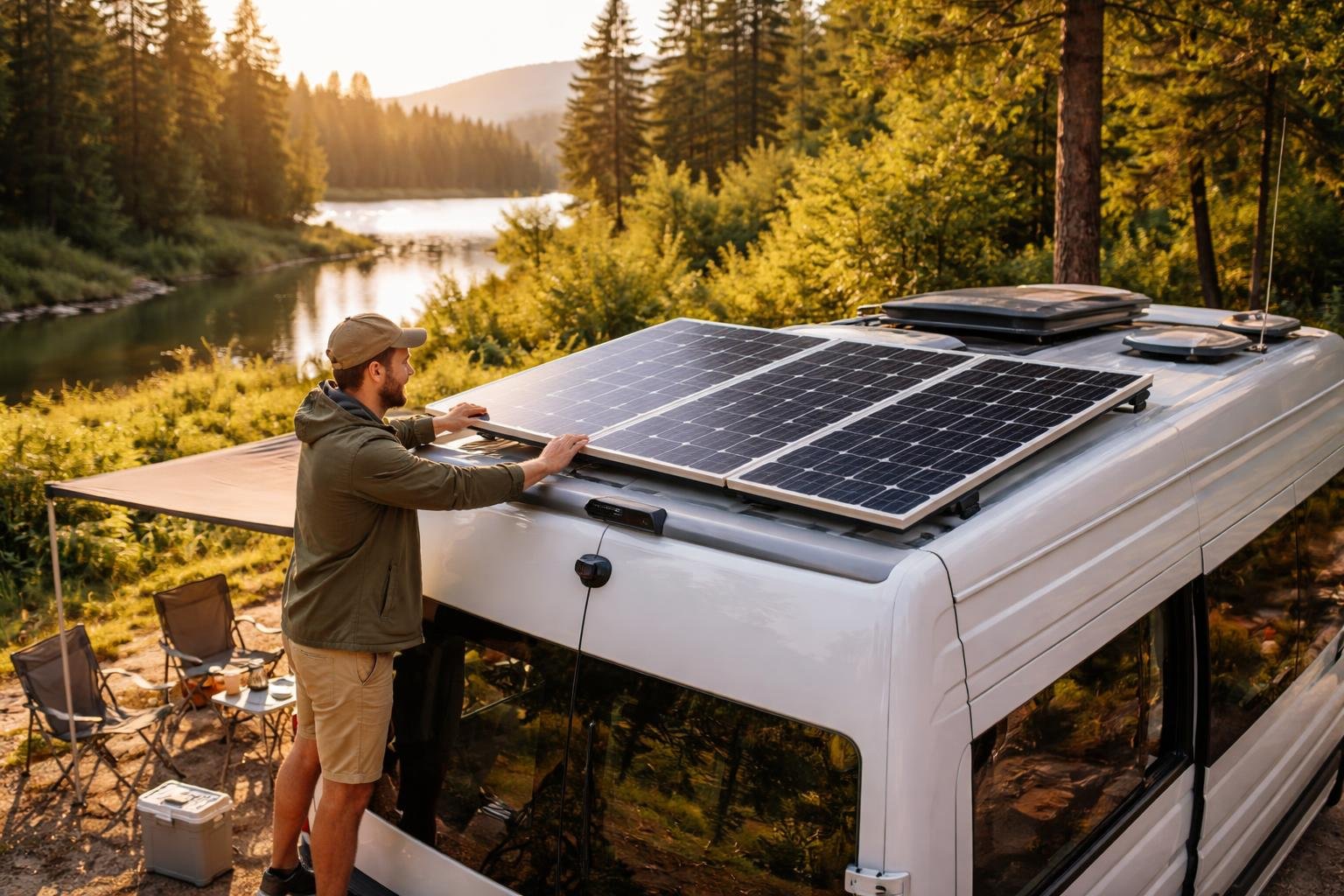
Most beginners need 200-400W of solar panels, a 100-200Ah LiFePO4 battery, an MPPT charge controller, and an inverter to get started. Installation involves mounting panels to the roof with brackets and sealant, then running wires through a cable entry gland to connect everything inside your van.
What’s a good starter solar power kit for a campervan?
A solid starter kit includes 200W of solar panels, a 20-30A MPPT charge controller, and a 100Ah LiFePO4 battery. This setup costs around $500-700 and powers basics like LED lights, phone charging, a vent fan, and a 12V fridge.
Renogy offers complete kits in this range that include all the major components. You’ll still need to buy wire, fuses, and mounting hardware separately.
If you want room to grow, consider buying a 200Ah battery from the start instead of upgrading later. The extra capacity gives you two days of power instead of one on cloudy days.
How do I install solar panels on my van’s roof?
Installing solar panels on your camper van starts with cleaning your roof thoroughly and planning panel placement to avoid roof vents and obstacles. You’ll mount the panels using Z-brackets or L-brackets that bolt through the roof.
Drill pilot holes for the bracket bolts. Seal each hole with Dicor self-leveling lap sealant before inserting the bolts to prevent leaks.
Tighten the brackets down and apply another layer of sealant over the bolt heads. Run your solar cables along the roof to a cable entry gland near the back or side of your van.
This waterproof fitting lets wires pass through the roof without creating leak points. Inside the van, connect the cables to your charge controller following proper polarity.
How much solar power do I need for casual van life adventures?
For weekend trips and casual adventures, you’ll typically use 800-1200Wh per day. This covers a 12V fridge, LED lighting, phone charging, and a fan.
A single 200W solar panel generates about 800-1000Wh per day in decent sun conditions. That’s enough for light use if you’re not running a laptop or other power-hungry devices.
If you plan to stay parked for multiple days without driving, bump up to 300-400W of panels to handle cloudy weather.
Can I fully power my van with solar panels, and if so, how many do I need?
Yes, you can fully power your van with solar if you size your system correctly and manage your energy use. Most full-time van lifers use 400-600W of solar panels with 200-300Ah of battery storage.
The number of panels depends on what you’re running. A fridge, laptop, lights, and fan need about 1200-1500Wh daily, which requires 300-400W of panels in average sun conditions.
You won’t be able to run an air conditioner or electric heater on solar alone. These devices draw too much power for typical van roof space.
Stick with a diesel heater for warmth and park in shade or use fans for cooling.
What are the must-have components for a beginner’s solar setup in a van?
Your van life solar setup needs four core components: solar panels, a charge controller, a battery bank, and an inverter. Each piece serves a specific purpose in capturing, storing, and delivering power.
Solar panels mount on your roof and generate electricity from sunlight. The MPPT charge controller regulates the power going into your battery to prevent overcharging.
Your LiFePO4 battery stores energy for nighttime use and cloudy days. The pure sine wave inverter converts 12V DC power to 120V AC for laptops and other household devices.
You’ll also need a fuse box, bus bars, appropriately sized wire, and various connectors. A battery monitor helps track your charge level so you don’t accidentally drain your battery too low.
Are there any user-friendly guides for setting up solar in a DIY camper van?
Several detailed guides walk you through the entire process from start to finish. Engineers Who Van Life offers a complete guide to solar power that covers panel selection, installation, and maintenance.
Van Life Theory provides an ultimate camper van solar setup guide with step-by-step instructions. Common questions are answered in detail.
Two Roaming Souls breaks down each solar component for beginners. This guide is helpful for those who find the electrical terminology confusing.
Most guides include wiring diagrams and sizing calculators. Following one guide from beginning to end helps avoid confusion.