Best Off Grid Appliances That Actually Save Power: Top Picks & Advice
Living off the grid doesn’t mean giving up modern comforts. The best off-grid appliances can cut your power use by 50-70%…
Living off the grid doesn’t mean giving up modern comforts. The best off-grid appliances can cut your power use by 50-70% compared to standard models while keeping your home running smoothly.
When you pick the right equipment, you spend less time worrying about battery levels and more time enjoying your sustainable lifestyle.
The key is knowing which appliances actually deliver on their power-saving promises. Some off-grid refrigerators use just 30-50 watts per hour, while certain propane stoves need zero electricity at all.
The right combination of solar-powered refrigerators, propane stoves, and energy-efficient appliances can transform your off-grid setup from a daily challenge into an efficient system.
Whether you’re planning a cabin retreat or making the full switch to off-grid living, choosing appliances that truly save power makes all the difference.
Key Takeaways
- Off-grid appliances reduce power consumption by up to 70% through efficient design and alternative fuel sources
- Essential power-saving appliances include solar refrigerators, propane water heaters, and 12-volt cooking devices
- Combining multiple power sources like solar panels and propane creates the most reliable off-grid system
How Off Grid Appliances Save Power
Off grid appliances cut energy waste through smart design choices that target real consumption, not just nameplate ratings. They eliminate standby drain, optimize motor efficiency, and help you track actual daily usage in measurable kilowatt-hours.
Understanding Energy Efficiency Off Grid
Energy efficiency means getting the same result with fewer watts. Traditional grid-tied homes rarely notice waste because power feels unlimited.
Off grid living forces you to pick energy-efficient appliances that deliver performance without draining your battery bank. DC refrigerators and inverter-compressor models use variable-speed motors that adjust output based on temperature, slashing energy use by 40-60% compared to older fixed-speed designs.
A standard AC fridge might pull 150-200 watts constantly. An efficient DC model sips 35-50 watts and cycles on only when needed.
Propane stoves and on-demand water heaters handle high-heat tasks without touching your solar reserves. This hybrid approach lets you reduce your carbon footprint while keeping electrical loads manageable.
Choosing the right fuel for each job is just as important as picking low-watt devices. When shopping, look past marketing claims.
Check independent test data for actual kWh per day under real conditions. A fridge rated “energy-efficient” might still consume 1.5 kWh daily if poorly insulated or tested in ideal lab temps.
The Importance of Daily kWh and Energy Audits
Your system capacity lives or dies on daily kWh budgets, not peak wattage. A 1,500-watt microwave sounds scary until you realize it runs 5 minutes per day (0.125 kWh).
A 100-watt fridge running 10 hours burns 1 kWh—eight times more impact. Start with a load audit.
List every device, its running watts, and daily runtime. Multiply to get kWh per day for each appliance.
Add them up and include a 20-25% overhead for inverter losses and cloudy days.
| Appliance | Watts | Hours/Day | kWh/Day |
|---|---|---|---|
| DC Fridge | 50 | 12 | 0.60 |
| LED Lights | 30 | 5 | 0.15 |
| Laptop | 65 | 4 | 0.26 |
| Total | 1.01 |
This daily total tells you exactly how much solar and battery capacity you need. Conducting regular energy audits keeps your system balanced as you add or swap appliances.
Minimizing Standby Power and Phantom Loads
Standby power drains batteries even when devices look “off.” Cable boxes, microwaves with clocks, phone chargers, and instant-on TVs can bleed 5-20 watts per device around the clock.
Over 24 hours that’s 0.12-0.48 kWh per gadget—enough to run LED lighting for an entire cabin. Kill phantom loads with switchable power strips or manual disconnect switches.
Unplug chargers when not actively charging. Replace always-on displays with battery-powered clocks.
Some off grid appliances work with manual controls instead of electronic standby circuits. Mechanical thermostats, analog timers, and toggle switches draw zero power when idle.
Choosing gear without “smart” features ironically makes your system smarter by eliminating waste you can’t see.
Power Sources for Off Grid Appliances
Running appliances off grid means you need reliable power that doesn’t come from utility lines. Solar power is the most popular choice for its silent operation and zero fuel costs.
Propane handles high-heat tasks like cooking and water heating, and backup generators fill the gaps during cloudy weeks or unexpected demand spikes.
Solar Power: Panels, Arrays, and Batteries
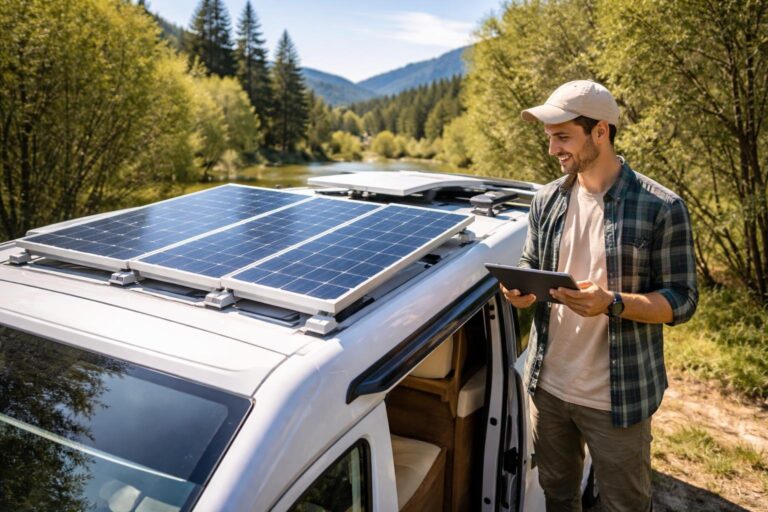
Solar panels capture sunlight and convert it into electricity that powers your appliances. A single panel produces around 100-400 watts.
Most off-grid homes use a solar array made up of multiple panels to generate enough daily power. Your solar panel system sends energy to battery storage during the day so you can run appliances at night.
Lithium batteries are the go-to choice because they last longer and charge faster than old lead-acid models. Most systems need 200-400 amp-hours of storage to keep a fridge, lights, and small electronics running through the night.
Key solar components:
- Panels: Monocrystalline work best in limited space
- Charge controller: Prevents overcharging your batteries
- Battery bank: Stores solar energy for nighttime use
- Monitoring system: Tracks daily generation and usage
A typical off-grid cabin running basic appliances needs around 400-800 watts of solar panels plus a 2-4 kWh battery bank. If you live in a cloudy region, add 30-50% more panel capacity to compensate for reduced sunlight.
Propane and Gas Alternatives
Propane appliances handle the jobs that drain solar systems the fastest. Cooking, water heating, and space heating all use massive amounts of electricity, but propane handles them efficiently without touching your battery bank.
A propane fridge uses no electricity and runs for weeks on a single tank. Propane ranges, ovens, and on-demand water heaters deliver instant heat without waiting for batteries to recharge.
Many off-grid homeowners use propane for 60-80% of their heating needs and save solar power for lights, phones, and refrigeration.
Best propane applications:
- Refrigerators (3-4 weeks per 20-lb tank)
- Cooking ranges and ovens
- Tankless water heaters
- Space heaters and furnaces
You’ll need to refill or exchange tanks every few weeks depending on usage. Keep two tanks on hand so you never run out mid-winter.
Backup and Emergency Power Options
Even the best solar setup has bad weather days. A gas-powered generator kicks in when your batteries run low or when you need to power heavy tools that exceed your solar capacity.
Portable power stations like the Marbero portable power station give you instant backup without starting a noisy generator. They charge from solar panels or AC outlets and deliver clean power for sensitive electronics.
Most units store 300-2000 watt-hours, enough to keep your essentials running during short outages. Generators rated at 2000-4000 watts cover most off-grid homes.
Run them during peak sun hours to charge batteries and power high-draw appliances at the same time. This hybrid approach reduces fuel consumption and extends battery life.
Choosing the Right Inverter for Your System
Inverters convert the DC power from your batteries into AC power that standard appliances use. Your inverter needs to handle both the continuous wattage of all running appliances plus the surge wattage when motors start up.
A fridge might run at 150 watts but spike to 600 watts at startup. Size your inverter for at least 2-3 times your largest motor load.
Most off-grid homes use 2000-3000 watt pure sine wave inverters to protect sensitive electronics and avoid motor damage.
Inverter types:
| Type | Best For | Cost |
|---|---|---|
| Modified sine wave | Simple resistive loads | $ |
| Pure sine wave | All appliances, motors | $ |
| Hybrid inverter-charger | Systems with generator backup | $$ |
Look for inverters with built-in battery chargers if you plan to use a generator for backup. This lets you charge batteries and run loads at the same time without extra equipment.
Essential Off Grid Kitchen Appliances
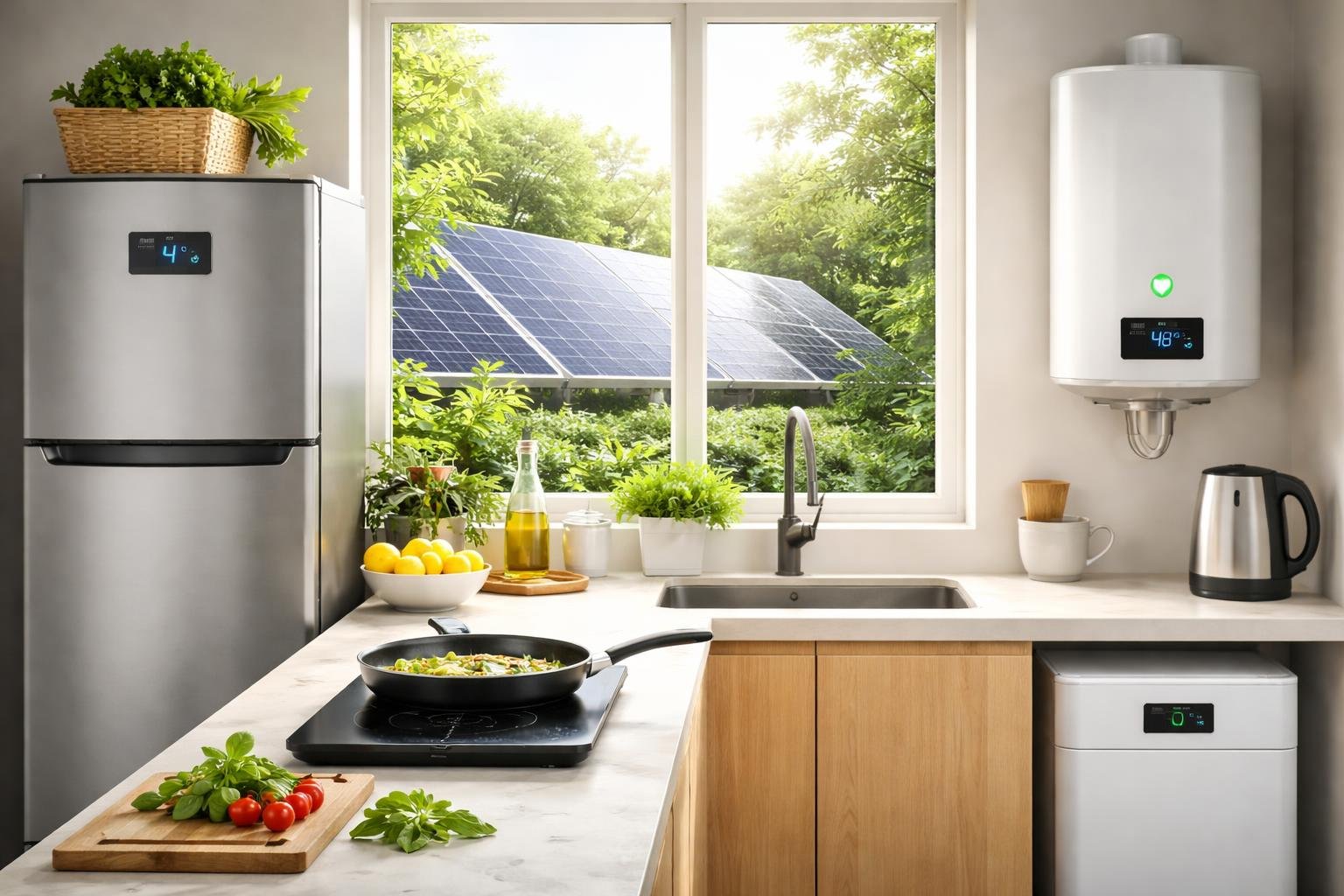
Setting up an off-grid kitchen means picking appliances that use minimal power while still getting the job done. Refrigeration typically consumes the most energy in any kitchen, so choosing the right fridge or freezer matters most.
Smart cooking appliances and water heaters round out your essential setup.
Choosing Refrigerators and Freezers That Save Power
Your refrigerator will likely be your biggest power draw, so selecting efficient off-grid appliances is critical. DC refrigerators running on 12V or 24V are your most efficient option because they skip inverter losses entirely.
These units typically use 0.5 to 1.0 kWh per day. If you need a larger capacity, look for inverter-compressor models.
These adjust their speed based on cooling demand instead of cycling on and off at full power. A good inverter-compressor fridge uses about 0.8 to 1.2 kWh daily.
Propane refrigerators offer another path. Propane fridges use zero electricity and work well if you already have propane tanks for cooking.
They’re perfect for areas with limited solar capacity. For food storage needs, chest-style freezers beat upright models because cold air stays inside when you open the lid.
Some people convert chest freezers into ultra-efficient refrigerators using external thermostats, cutting power use by 60% or more.
| Fridge Type | Daily Power Use | Best For |
|---|---|---|
| DC Refrigerator | 0.5-1.0 kWh | Small cabins, RVs |
| Inverter Compressor | 0.8-1.2 kWh | Full-time homes |
| Propane Fridge | 0 kWh | Limited solar setups |
Efficient Cooking: Stoves, Ovens, and More
Electric cooking appliances drain batteries fast, so most off-grid kitchens rely on alternative fuel sources. Propane stoves and propane ranges deliver instant heat without touching your electrical system.
A standard propane range uses about 35,000 BTU per hour on high, and a 20-pound tank lasts roughly 18-24 hours of cooking time. Wood-burning cookstoves provide both cooking heat and space heating.
A quality wood stove lets you bake, simmer, and boil while warming your home during cold months. Rocket stoves offer a more compact, highly efficient wood-burning option that uses small sticks and twigs.
For sunny days, solar ovens cook food using only sunlight. They reach 300-350°F and work great for baking bread, roasting vegetables, or slow-cooking meals.
Slow cookers and thermal cookers also save energy by cooking food over many hours at low wattage, or in the case of thermal cookers, using retained heat after an initial boil. You can use small electric appliances like pressure cookers or induction stove tops during peak solar production hours, but save high-draw cooking for propane or wood to protect your battery bank.
Off Grid Water Heaters for Kitchen and Bath
Heating water electrically is one of the worst energy drains for off-grid living. Traditional electric water heaters can pull 3,000 to 5,500 watts, making them incompatible with most solar setups.
Propane water heaters solve this problem efficiently. Tankless propane water heaters heat water on demand without storing hot water in a tank, eliminating standby heat loss.
A tankless unit uses no electricity except for a small ignition circuit that draws under 1 watt.
Solar water heaters use roof-mounted collectors to pre-heat water before it enters your propane heater. This hybrid approach cuts propane consumption by 50-70% while requiring zero battery power.
Solar water heaters work year-round in most climates. Efficiency drops during winter.
For maximum energy savings, insulate all hot water pipes and place your water heater close to your kitchen and bathroom.
Every foot of pipe between the heater and faucet wastes heat and water while you wait for hot water to arrive.
Other Must-Have Power-Saving Off Grid Appliances
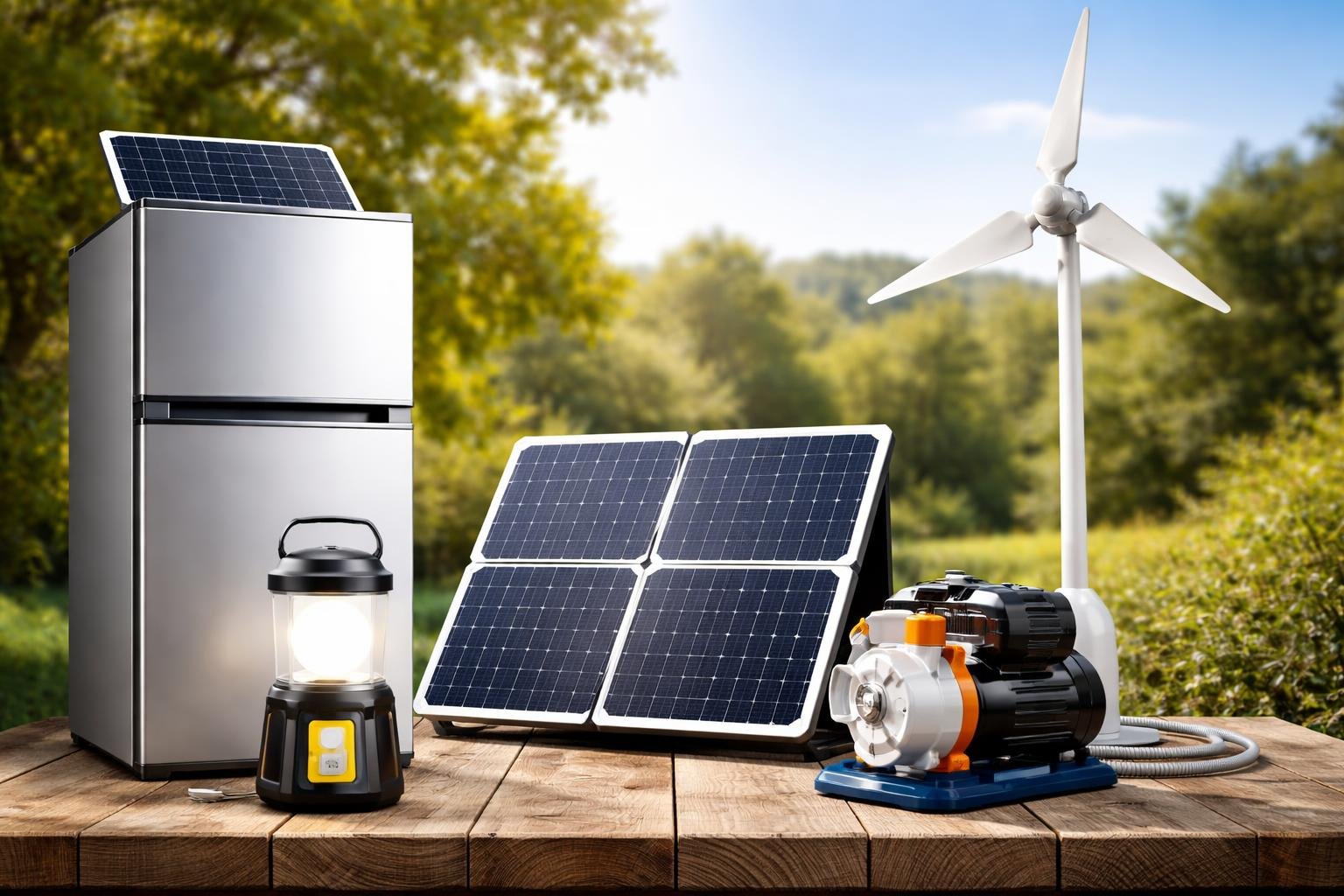
Laundry solutions, waste management systems, and climate control equipment round out the essentials for comfortable off-grid living.
These appliances help you maintain daily routines while keeping power consumption low.
Laundry and Drying
Your laundry setup doesn’t need to drain your power reserves. Manual washing machines use zero electricity and work through hand-cranking mechanisms that agitate clothes in a similar way to traditional washers.
For an off-grid washer and dryer setup, you can choose propane-powered models that handle larger loads.
These units cost between $70 and $200 for manual options.
Off-grid dryers present several power-saving choices. Solar clothes dryers use natural sunlight and cost nothing to operate after installation.
Propane dryers offer faster drying times when weather doesn’t cooperate.
A simple clothesline or drying rack eliminates power use entirely.
You can also find 12-volt powered dryers that run off your battery bank during sunny days when you have excess solar production.
Off Grid Toilets and Sanitation Solutions
Composting toilets eliminate water waste and power consumption while handling human waste safely. These systems separate liquid and solid waste, using natural decomposition to break down solids into usable compost.
A composting toilet requires no plumbing or electricity for basic models.
Prices range from $900 to $2,500 depending on capacity and features.
Key benefits of composting toilets:
- Zero water consumption per flush
- No septic system needed
- Creates fertilizer for non-edible plants
- Works in any climate
- Requires emptying every few months
Some composting toilet models include small fans that run on 12-volt power to reduce odors.
The fan draws minimal power compared to traditional sewage systems.
Maintaining Air Circulation & Comfort
Proper air circulation keeps your space comfortable without consuming excessive power. Solar-powered fans move air throughout your home using 12-volt DC power directly from your battery bank.
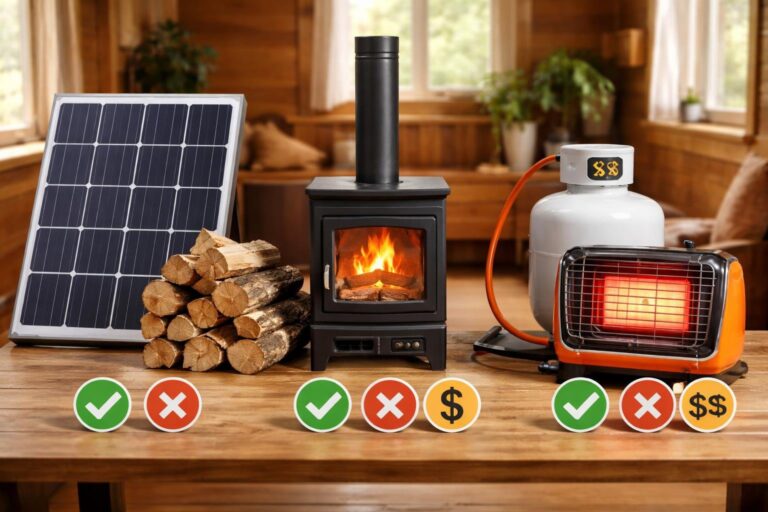
A quality space heater designed for off-grid use typically runs on propane rather than electricity. Propane heaters provide reliable warmth without depleting your solar battery storage during winter months when sun exposure is limited.
Important safety considerations:
- Install carbon monoxide detectors in any space with propane heating
- Ensure proper ventilation for fuel-burning appliances
- Test detectors monthly
- Replace detector batteries twice yearly
Ceiling fans that operate on 12-volt systems use roughly 10-30 watts compared to 75 watts for standard AC fans.
You can also use passive cooling strategies like opening windows during cooler evening hours and closing them during peak heat.
Smart Strategies for Sustainable Off Grid Living
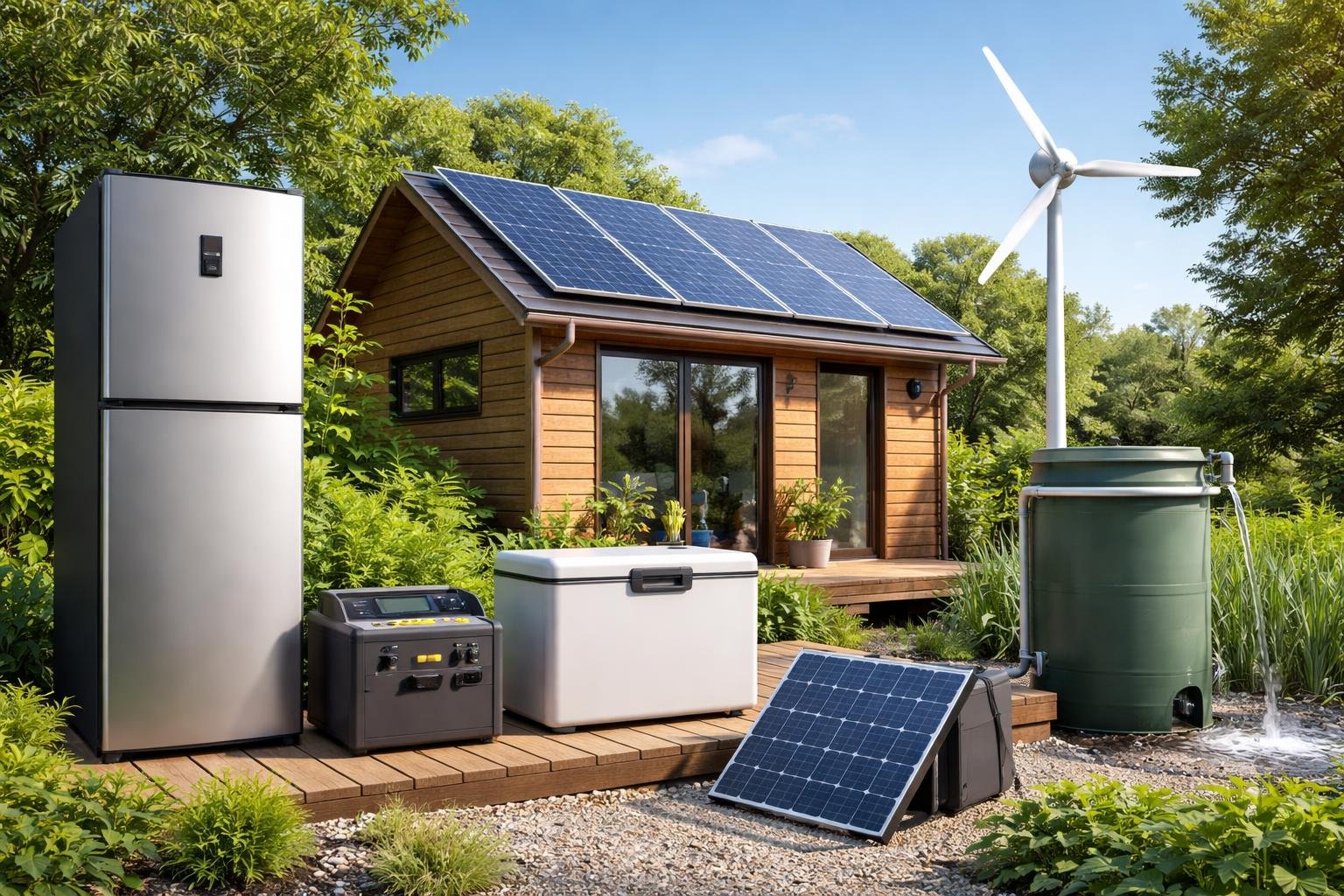
Making the switch to an off-grid lifestyle requires careful planning around energy independence and regular upkeep of your systems.
You’ll need to balance your power usage with what your setup can actually produce while keeping everything running smoothly.
Self-Sufficiency and Energy Independence
Building true self-sufficiency means understanding your energy needs before you buy anything. Start by calculating your daily power consumption in kilowatt-hours.
Most off-grid homes use between 5 and 15 kWh per day, compared to 30 kWh for typical grid-connected homes.
Your path to energy independence starts with choosing appliances that use less than 1 kWh per day. Solar-powered refrigerators with DC compressors are more efficient than standard models because they skip the energy-wasting conversion from DC to AC power.
Create a backup plan for cloudy days or equipment failures. Store extra propane tanks if you rely on gas appliances.
Keep manual alternatives like hand-crank washing machines ready for when your solar system needs maintenance.
Track your energy production and usage with a monitoring system. This helps you spot problems early and adjust your habits before you run out of power.
Maintenance Tips for Off Grid Appliances
Regular maintenance keeps your off-grid appliances working longer and using less energy. Check your solar panels monthly for dirt, leaves, or snow that blocks sunlight.
Clean panels can produce up to 25% more power than dirty ones.
Inspect propane connections every three months using soapy water to spot leaks. Look for bubbles forming around fittings and hoses.
Replace any cracked or worn hoses immediately to prevent dangerous gas leaks.
Wood-burning stoves need their chimneys cleaned at least once per year to prevent creosote buildup. Empty composting toilets according to the manufacturer’s schedule, usually every few months depending on usage.
Battery banks require the most attention. Check water levels in flooded lead-acid batteries monthly and add distilled water when needed.
Keep terminals clean and tight to maintain good connections.
Scaling and Upgrading Your Off Grid System
Start small and expand as you learn what works for your off-grid homestead. Begin with essential appliances like refrigeration and cooking, then add comfort items as your power system proves reliable.
Add solar panels in groups that match your inverter capacity. Most systems can handle 20-30% more panels than originally installed without major upgrades.
Installing portable solar generators gives you flexible backup power that grows with your needs.
Upgrade your battery bank before adding high-draw appliances. Each major appliance needs enough stored power to run for at least three days without sun.
Calculate the watt-hours each new device uses and multiply by 72 hours.
Plan upgrades around emergency preparedness too. Add redundant systems for critical functions like water pumping and refrigeration.
Having two smaller systems beats relying on one large setup that leaves you stranded if it fails.
Frequently Asked Questions
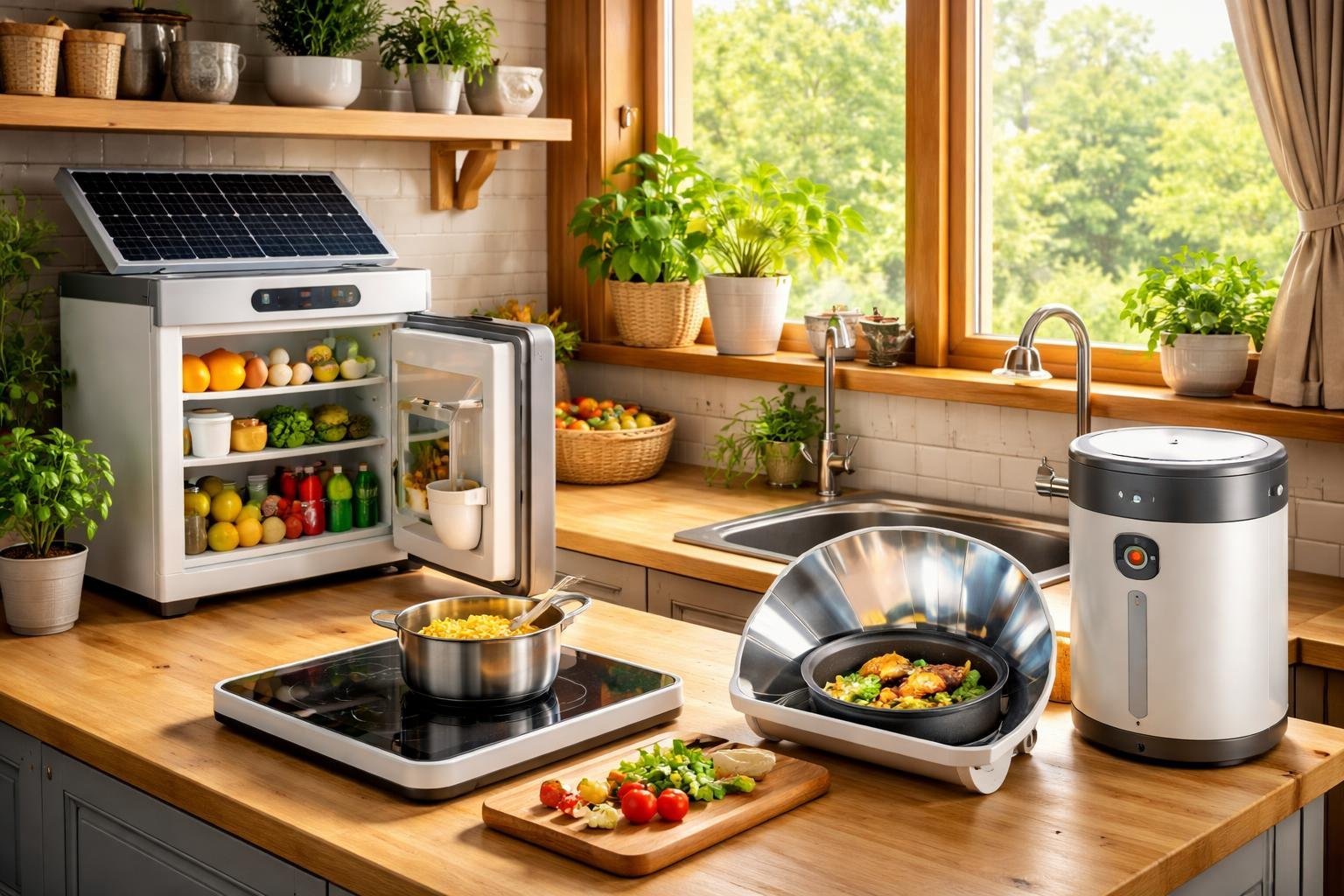
Choosing the right appliances for off-grid living means balancing power needs with practical features.
Most people want to know which specific appliances work best in kitchens, what propane options exist, and how to avoid energy-draining mistakes.
What are some top energy-saving appliances for an off-grid kitchen?
Your kitchen needs a few key appliances that won’t drain your power system. A propane stove is one of the best choices because it uses zero electricity and gives you reliable heat for cooking.
Off-grid refrigerators that run on solar power or propane typically cost between $300 and $2,000.
Many models can switch between power sources, so you have a backup when sunlight is low.
A slow cooker that runs on 12-volt DC current draws minimal power from your battery system. You can make soups and casseroles without using much energy at all.
Portable pizza ovens fueled by wood or pellets are another smart option. They need no electricity and can reach high temperatures quickly.
Can you recommend efficient propane appliances for off-grid living?
Propane water heaters are some of the best off-grid propane appliances you can install. They heat water only when you turn on the tap, which saves fuel compared to keeping a tank hot all day.
Full-sized propane stoves and ovens give you the cooking power you’re used to. They typically cost between $200 and $1,500 depending on size and features.
Propane refrigerators offer reliable food storage without needing solar panels or batteries. You just need to refill your propane tank regularly.
Propane-powered washers and dryers can handle larger laundry loads than manual options. They’re not essential, but they make life easier if you have the budget.
What’s the coolest unique appliance that won’t hog my power supply?
A manual washer is one of the most interesting off-grid appliances because it uses no power at all except your own effort. You can wash clothes without generators or solar panels.
Wood-burning hot tubs are luxury items that run without electricity. They take longer to heat up than propane versions, but they create a relaxing experience using only firewood.
Portable freezers that run on 12-volt power are versatile because many models can switch between freezer and refrigerator modes. They’re perfect for short trips or as backup storage.
Charcoal grills give you great flavor without using propane or electricity. They’re simple, reliable, and cheap to operate.
How do I pick out appliances that will help me maintain an efficient off-grid lifestyle?
Look for appliances with lower wattage ratings when you’re shopping. The less power they need, the smaller your solar panel system or generator can be.
Choose appliances that offer multiple power source options. A refrigerator that runs on both solar and propane gives you flexibility when weather conditions change.
Think about how often you’ll actually use each appliance. A bread maker might seem nice, but if you only bake once a month, the space and cost aren’t worth it.
Read reviews from other off-grid users before buying. They’ll tell you about real-world performance and any hidden problems.
Which off-grid electricity sources are the most cost-effective for running appliances?
Propane is the most budget-friendly option upfront. You can start using propane appliances right away without expensive equipment installation.
Solar panels cost more initially but save money over time. After you pay for the panels and installation, sunlight is free.
Wind power works well in certain locations but requires steady wind to be reliable. It’s best combined with solar or propane as a backup.
Gas-powered generators are cheap to buy but expensive to run long-term. They also create carbon monoxide, which is dangerous and odorless, so you need CO detectors if you use them.
Are there any appliances I should avoid if I’m trying to conserve energy off-grid?
Electric resistance heaters are power hogs that will drain your batteries fast. Stick with propane heaters or wood stoves instead.
Traditional electric water heaters that keep a tank hot 24/7 waste massive amounts of energy. Propane tankless heaters are much more efficient.
Air conditioners use huge amounts of electricity and are hard to run off-grid. Fans, good insulation, and passive cooling techniques work better.
Electric dryers pull way more power than they’re worth. Hanging clothes on a line or using a propane dryer makes more sense for sustainable living.