Off Grid Heating Options: Pros, Cons, and Costs Explained
Living off the grid means rethinking how you stay warm during cold months. The best off grid heating options include wood…
Living off the grid means rethinking how you stay warm during cold months.
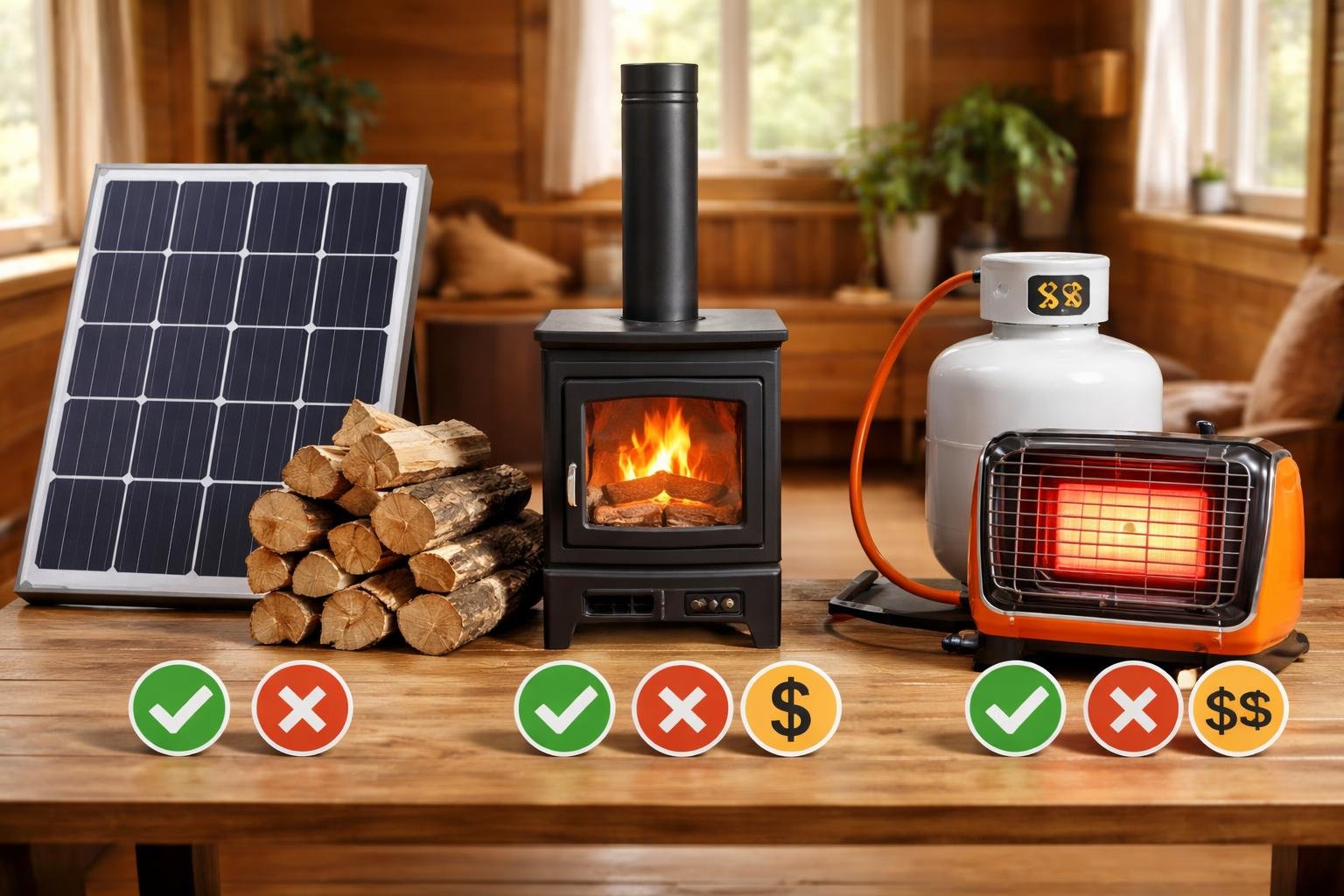
The best off grid heating options include wood stoves at $800-3,000, propane heaters at $300-2,500, and solar heating systems at $3,000-10,000, each with distinct pros and cons for fuel costs, maintenance, and reliability.
Your choice depends on your budget, climate, and how much hands-on work you want to handle.
Picking the wrong heating system can leave you cold, broke, or stuck with endless maintenance.
Some off grid cabin heating options work great in certain climates but fail in others.
Understanding what each system really costs beyond the sticker price helps you avoid expensive mistakes.
This guide breaks down the real costs, daily requirements, and trade-offs for every major heating option.
You’ll learn which systems need constant attention, which ones drain your wallet on fuel, and which ones actually deliver reliable warmth when you need it most.
Key Takeaways
- Wood stoves offer the cheapest long-term heating if you have access to free firewood but require daily maintenance and chimney cleaning
- Propane heaters provide convenient set-and-forget heating but come with ongoing fuel costs that add up quickly in remote locations
- Solar heating works well as a supplement during sunny months but cannot serve as your only heat source in winter
Understanding Off Grid Heating: Basics, Needs, and Challenges
Off-grid heating requires careful planning based on your power source, local climate, and the size of your space.
Getting these fundamentals right means the difference between staying warm all winter and wasting money on a system that can’t keep up with your needs.
What Makes a Heating System Truly Off Grid
A heating system becomes truly off-grid when it operates without connection to utility companies or the electrical grid.
This means your heat source runs independently using fuel you can store, gather, or generate yourself.
Wood stoves and pellet stoves count as off-grid heating options because they don’t need electricity to function.
You control the fuel supply directly.
Propane heaters with standing pilot ignition systems also qualify since they light without electrical power.
Some systems seem off-grid but aren’t fully independent.
Many pellet stoves need electricity to run their augers and fans.
You can connect these to solar panels or generators, but you’re still dependent on maintaining that power source.
The key question is whether your heating system works when everything else fails.
Can you heat your home during a power outage or if fuel deliveries stop?
True off-grid heat gives you that independence.
Key Factors: Climate, Space, and Fuel Availability
Your climate determines how much heating power you need throughout the year.
Cold regions require more robust systems that can handle extended freezing temperatures.
Milder climates might need only supplemental heat during occasional cold snaps.
Space layout affects heat distribution in major ways.
Open floor plans let warmth spread naturally from a central source.
Homes with multiple rooms or levels need strategies to move heat around effectively or multiple heating units.
Fuel availability matters more than anything for long-term success.
Wood stoves work great if you have access to timber, but they’re impractical in treeless areas where you’d need to buy and haul firewood constantly.
Propane requires regular deliveries and storage tanks.
Your location determines which fuel sources make sense financially and logistically.
Heating Power: Sizing by BTUs and Your Space
BTUs (British Thermal Units) measure heating power output.
You need roughly 3,000 BTUs to heat 100 square feet of space.
A 1,200 square foot home requires about 36,000 BTUs on average.
A standard four cubic foot wood stove produces 100,000 BTUs, enough for 3,000 square feet.
But actual heating depends on insulation quality, ceiling height, and how many windows you have.
Undersized systems run constantly and struggle to maintain comfortable temperatures.
Oversized units waste fuel and money.
Calculate your space’s needs before buying equipment.
Different heating options produce varying BTU output levels.
Propane and kerosene heaters come in multiple sizes with different power ratings.
Match your system’s BTU capacity to your actual space requirements for efficient off grid heating.
Wood Stoves and Biomass: Independence and Labor
Wood and biomass heating systems give you true energy independence but require hands-on work and planning.
You’ll need to understand how different systems operate, what maintenance they demand, and how to keep them running safely through winter.
Wood Burning Stove: Operation, Efficiency, and Upkeep
A wood burning stove heats your space by burning logs in a firebox and radiating heat through metal or cast iron surfaces.
Modern EPA-certified stoves achieve 60-80% efficiency through better combustion design compared to older models.
You’ll get the best performance from your stove when you burn seasoned hardwood that’s been dried for at least six months.
Wet or green wood creates more smoke and leads to creosote buildup in your chimney, which can cause dangerous fires.
Daily tasks include:
- Loading firewood every 4-8 hours
- Removing ash from the firebox
- Adjusting air controls for optimal burn
You’ll also need to sweep your chimney 1-2 times per heating season to remove creosote.
Popular models like the Drolet Escape 1800 can heat up to 2,400 square feet and burn for 8 hours on a single load.
These stoves require a proper hearth pad underneath and clearance from walls to meet safety codes.
Pellet Stoves and Biomass Boilers: Features and Differences
Pellet stoves burn compressed wood pellets and offer automated operation that wood stoves can’t match.
They feed fuel automatically from a hopper, maintain consistent temperatures, and only need ash removal once a week.
A pellet stove works well for heating single rooms or open floor plans.
You’ll need to refill the hopper every 1-2 days depending on the size and heat setting.
Pellet stoves achieve 70-83% efficiency and produce less ash than traditional wood stoves.
Biomass boilers are larger systems that heat water for radiators or radiant floors throughout your entire home.
They can burn wood pellets, chips, or logs and often include automatic fuel feeding.
These units achieve up to 90% efficiency but cost $8,000-$20,000 installed.
The main challenge with pellet systems is pellet availability in your area.
You’ll need storage space for bags or bulk delivery, and prices typically run $200-$300 per ton.
Masonry and Rocket Mass Heaters: Old-School Meets Modern Efficiency
Masonry heaters store heat in thousands of pounds of brick, stone, or tile.
You burn a hot, fast fire once or twice daily, and the mass releases warmth for up to 24 hours.
These systems reach 80-90% efficiency through complete combustion.
A masonry heater costs $8,000-$15,000 to build but lasts decades with minimal maintenance.
You’ll use less wood than a regular stove because efficient wood burning extracts more energy from each log.
Rocket mass heaters combine rocket stove combustion with thermal mass storage.
They burn small amounts of wood at extremely high temperatures in an insulated chamber, then channel exhaust through a thermal mass bench or floor before venting outside.
Key benefits:
- Use 70-90% less wood than traditional stoves
- Produce almost no visible smoke
- Cost $500-$3,000 for DIY builds
Both systems require custom construction and may face building code challenges in some areas.
Installation, Maintenance, and Safety for Wood Heating
Wood stove installation requires careful planning for safety and efficiency.
You’ll need a proper hearth pad extending at least 18 inches in front and 8 inches on the sides.
Your stove must sit at least 36 inches from combustible walls unless you install heat shields.
The chimney system matters just as much as the stove itself.
You’ll want double-wall or triple-wall insulated pipe running through your home, and it needs to extend at least 3 feet above the roof penetration point.
Annual maintenance checklist:
- Inspect door gaskets and replace if worn
- Check chimney for creosote buildup
- Clean ash from internal baffles
- Verify proper draft with smoke test
Chimney cleaning becomes critical when creosote accumulates to 1/4 inch thickness.
You can do this yourself with brushes and rods or hire a professional for $150-$300.
Store at least one season’s worth of firewood in a dry, covered location.
Budget 3-5 cords annually for full-time heating depending on your climate and home size.
Split and stack wood in spring so it dries through summer for fall burning.
Propane and Kerosene Heaters: Convenience Meets Ongoing Costs
Propane and kerosene heaters deliver heat without electricity, but you’ll pay for fuel throughout the heating season.
Your choice between portable and permanent models affects both upfront investment and long-term expenses, while proper ventilation and safety equipment remain non-negotiable.
Types: Portable vs. Permanent Propane Heaters
Portable propane heaters give you flexibility to move heat where you need it.
The Mr. Heater Big Buddy is a popular choice that connects to small one-pound propane cylinders or larger tanks with an adapter.
These units work well for heating single rooms, garages, or workshops.
You can also install permanent propane heating systems with wall-mounted or freestanding units.
These connect directly to a large propane tank outside your home.
Permanent systems heat multiple rooms or your entire house more efficiently than portable models.
Propane heaters offer quick heating and reach your desired temperature fast.
Many portable units include built-in safety features like tip-over switches and oxygen depletion sensors.
Kerosene heaters work similarly to portable propane models.
You fill them with kerosene fuel and light the wick.
They don’t need electricity and can heat large spaces effectively.
Operating Costs, Fuel Storage, and Delivery
Propane costs vary by region but typically run $2 to $4 per gallon.
A 20-pound tank holds about 4.7 gallons and costs $15 to $25 to refill.
You’ll go through fuel quickly during cold months.
Kerosene generally costs less than propane in most areas, making it more economical for extended use.
You can buy kerosene at gas stations or fuel suppliers for around $3 to $5 per gallon.
You need to store propane in approved tanks outside your home.
Small portable propane heaters use one-pound cylinders you can keep indoors.
Larger systems require 100 to 500-gallon tanks that sit outside and need professional delivery and refills.
Kerosene storage is simpler since you can keep 5-gallon containers in your garage or shed.
You transport kerosene yourself instead of scheduling deliveries.
Both fuels have shelf lives of several years when stored properly in sealed containers away from heat sources.
Propane and Kerosene Safety: CO Detectors and Ventilation
Both propane heaters and kerosene heaters produce carbon monoxide and require proper ventilation.
You must crack a window or door when running these heaters indoors to prevent dangerous gas buildup.
Installing a CO detector is essential when using any fuel-burning heater.
Place detectors on every level of your home and near sleeping areas.
Test them monthly and replace batteries twice yearly.
Propane models often include automatic shut-off valves that activate when oxygen levels drop too low.
These safety features reduce risk but don’t eliminate the need for ventilation.
Keep both heater types away from flammable materials like curtains, furniture, and papers.
Maintain a three-foot clearance zone around all sides.
Never leave heaters unattended while running or use them overnight while sleeping.
Kerosene heaters emit more odor than propane during operation.
Some people find the smell unpleasant in enclosed spaces.
Proper ventilation reduces emissions and keeps indoor air quality safer for your family.
Solar Heating Solutions: Free Energy With Limits
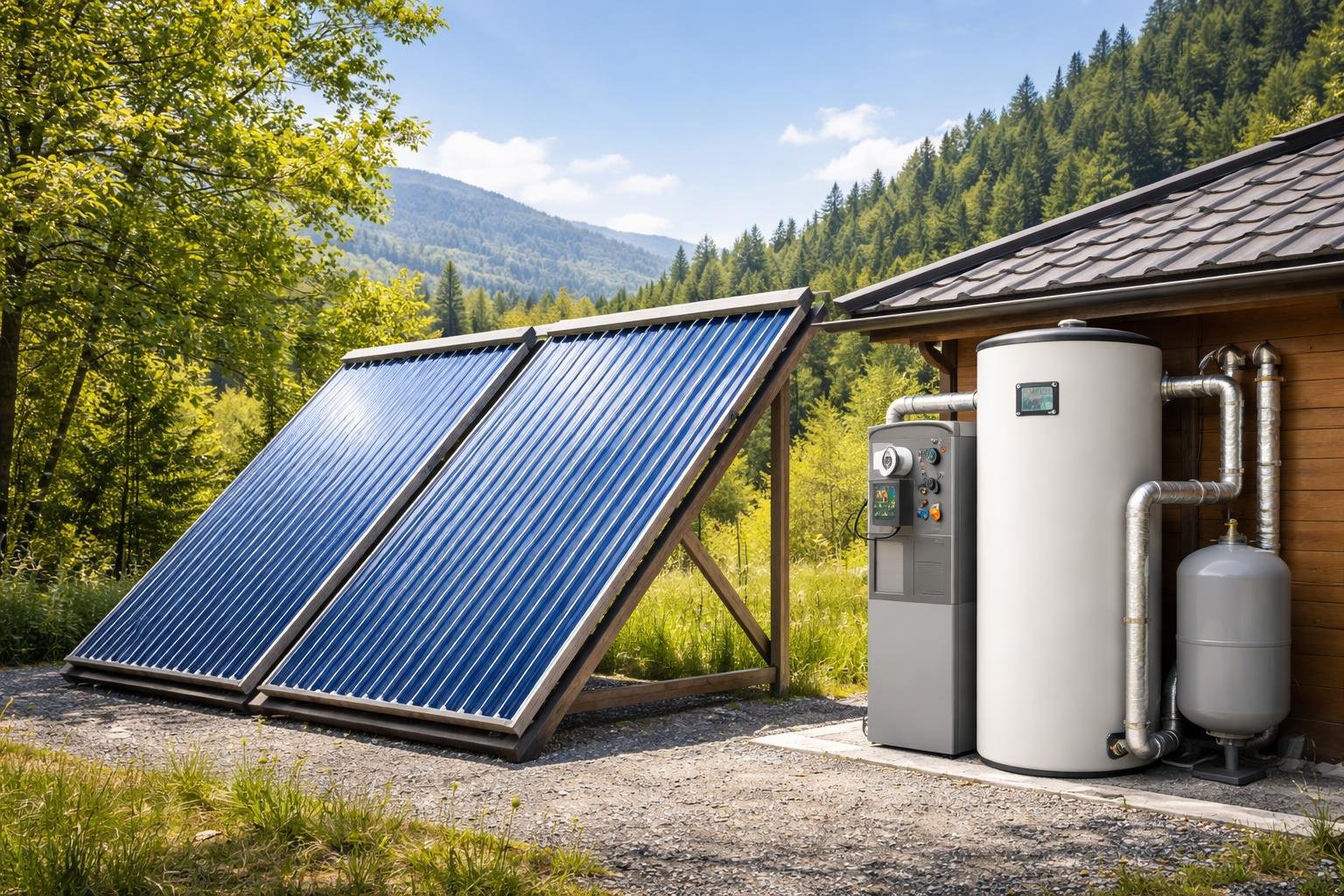
Solar heating captures the sun’s energy to warm your space without ongoing fuel costs. Performance drops significantly during cloudy weather and winter months when you need heat most.
Both passive and active systems can supplement or fully replace traditional heating depending on your climate, budget, and home design.
Passive Solar Design: Making the Most of Natural Light
Passive solar heating uses your home’s structure to capture and store heat from sunlight without mechanical equipment. South-facing windows let in winter sun at low angles, which hits thermal mass like concrete floors, brick walls, or water containers that absorb heat during the day.
When temperatures drop at night, the stored heat radiates back into your living space. Properly designed passive solar homes can obtain 50-70% of heating needs from the sun in sunny climates.
Key design elements include:
- South-facing glass sized at 7-12% of floor area
- 4-6 inches of concrete, brick, or water for thermal mass
- Roof overhangs that block summer sun but allow winter sun
- R-30 wall insulation and R-50 ceiling insulation minimum
- Window quilts or shutters to prevent nighttime heat loss
You can add passive solar features to existing homes through sunspace additions ($2,000-8,000 DIY) or Trombe walls ($1,500-5,000). Trombe walls are glass-faced masonry walls on the south side that capture and slowly release heat.
Active Solar Heating Systems: Collectors, Panels, and Storage
Active solar heating uses solar collectors or panels to capture heat. The heat is distributed through your home with pumps or fans.
These systems require more equipment and complexity than passive designs but work with any building orientation. Solar thermal panels contain fluid that heats up in the sun, then transfers warmth to water tanks or radiant floor systems.
A typical setup needs 20-40 square feet of collector area per person for water heating, or 0.5-1 square feet per square foot of floor space for home heating.
System costs vary widely:
- DIY solar air heater: $200-800
- Professional solar water heater: $3,000-7,000
- Whole-home solar thermal: $10,000-25,000
Battery storage becomes necessary if you want heat after sunset. Most active solar heating systems store energy as hot water in insulated tanks rather than electrical batteries, which is more efficient and affordable for heating applications.
Solar Air and Water Heaters: How They Work
Solar air heaters pull cold air from your room, pass it through a dark-colored collector box mounted on a south wall or roof, then return the heated air inside. These simple devices can raise air temperature by 40-70°F on sunny days.
A basic solar air heater provides 5,000-15,000 BTU and costs $200-800 for DIY models. You mount the collector where it gets full sun from 9am-3pm, and warm air circulates through vents naturally or with a small fan.
Solar water heaters work differently. Collectors heat antifreeze fluid that flows through a heat exchanger in your water tank.
The system includes freeze protection and backup heating for cloudy periods. These systems excel at preheating water, reducing your backup heating fuel use by 50-80% in sunny climates.
They provide hot water year-round but contribute less to space heating unless connected to radiant floors.
Key Considerations: Battery Backup, Thermal Mass, and Cloudy Days
Solar heating performance drops dramatically during extended cloudy periods and short winter days when heating demand peaks. You need backup systems or enough thermal mass to carry you through sunless stretches.
Thermal mass in passive solar homes stores 1-3 days of heat depending on mass volume and insulation quality. Concrete stores about 23 BTU per cubic foot per degree of temperature change.
A 400 square foot concrete slab 4 inches thick provides roughly 15,000 BTU of storage capacity per 10°F temperature swing. Battery backup for active solar systems adds $3,000-10,000 to system costs.
You’re better off storing solar energy as hot water in insulated tanks, which costs less and loses energy more slowly than electrical batteries.
Solar heating limitations to plan for:
- Output drops 70-90% on overcast days
- Winter sun angles reduce collection efficiency
- North-facing homes get minimal benefit
- Trees and buildings create shading issues
- Most systems provide supplemental heat only
Your climate determines solar heating viability. Areas with 200+ sunny days annually see the best performance, while cloudy regions need larger collector areas and more backup heating capacity.
Heat Pumps, Radiant, and Electric: Modern Tech for Off Grid Heat
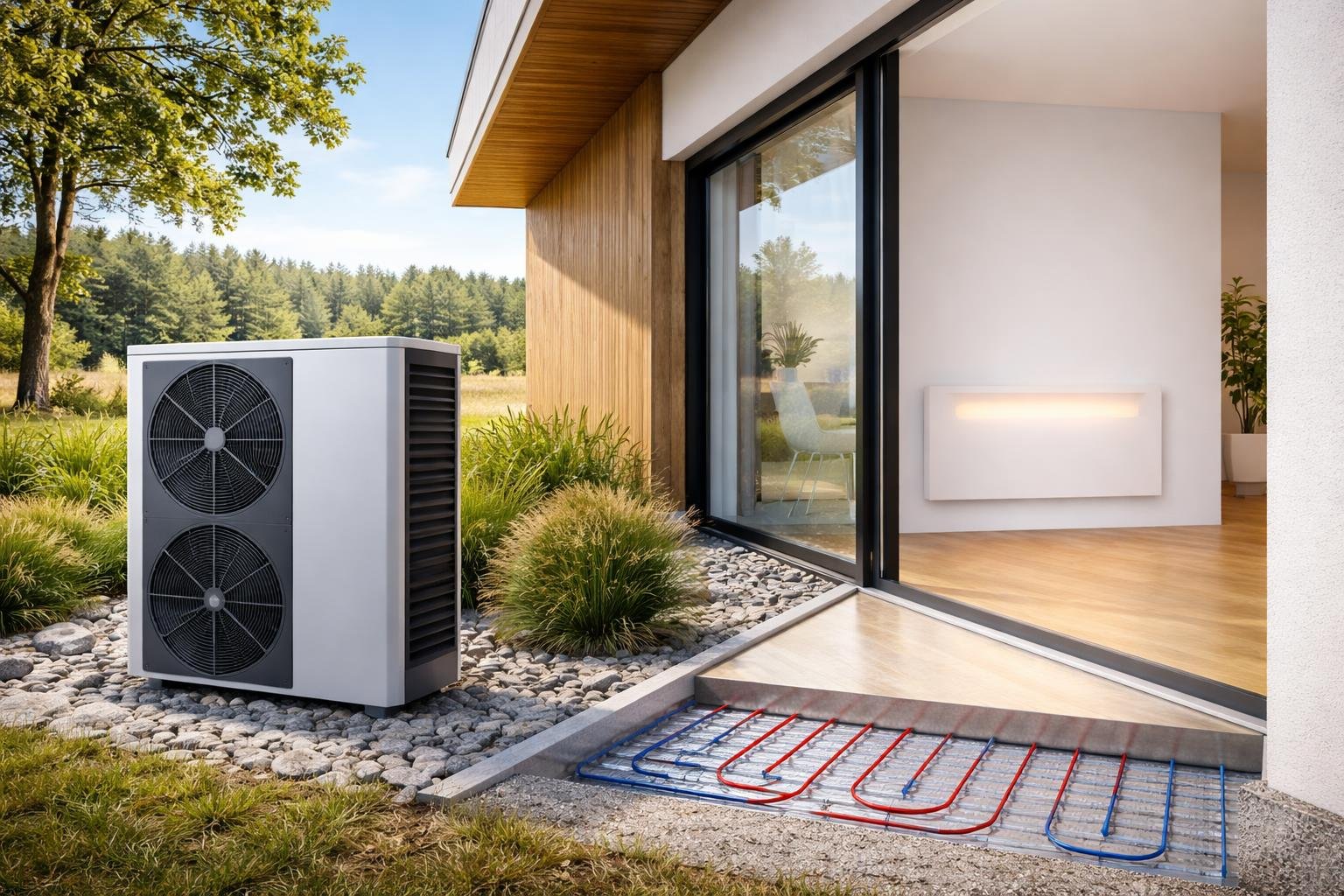
Modern heating technology can work off grid when paired with solar panels or other power sources. Heat pumps deliver impressive efficiency in the right climate, while radiant systems provide consistent warmth underfoot.
Air-Source and Geothermal Heat Pumps: Pros and Cons
Air-source heat pumps pull warmth from outside air and transfer it into your home. They can cut energy use by up to 60% compared to traditional systems.
Modern cold climate heat pumps work in freezing temperatures, though efficiency drops as it gets colder. Geothermal heat pumps tap into stable underground temperatures.
They cost more upfront but deliver steady performance year-round. You’ll need to drill wells or dig trenches, which adds $10,000 to $30,000 to installation costs.
Heat Pump Pros:
- Very energy efficient
- Provides cooling and heating
- Works with solar power
Heat Pump Cons:
- Requires electricity
- High installation costs
- Air-source models struggle in extreme cold
Radiant Floor and Underfloor Heating: Efficiency and Comfort
Radiant floor heating pushes warm water through pipes under your floor. The heat rises evenly throughout the room without noisy fans or vents.
Radiant systems can reduce energy use by 30% compared to forced air heating. You can power radiant heating with a biomass boiler, solar thermal panels, or a heat pump.
The system works great with concrete floors that hold heat well. Installation costs run $6 to $20 per square foot depending on your setup.
The warmth feels natural and consistent. You won’t deal with cold spots or drafts.
Radiators connected to the same system can heat rooms without floor loops.
Electric Space Heaters: Usability Off Grid
Electric space heaters only make sense off grid if you generate your own power. They pull serious electricity, often 1,500 watts per unit.
That’s a lot to ask from solar panels during winter when you need heat most. You’d need a large battery bank and solar array to run electric heating reliably.
Most off-gridders avoid electric space heaters because they drain power fast. They work better as backup heat in a single room rather than your main heating source.
If you have excess solar power on sunny days, electric heaters can supplement other heating methods. Just don’t count on them as your primary solution.
Comparing Costs and Making the Right Choice
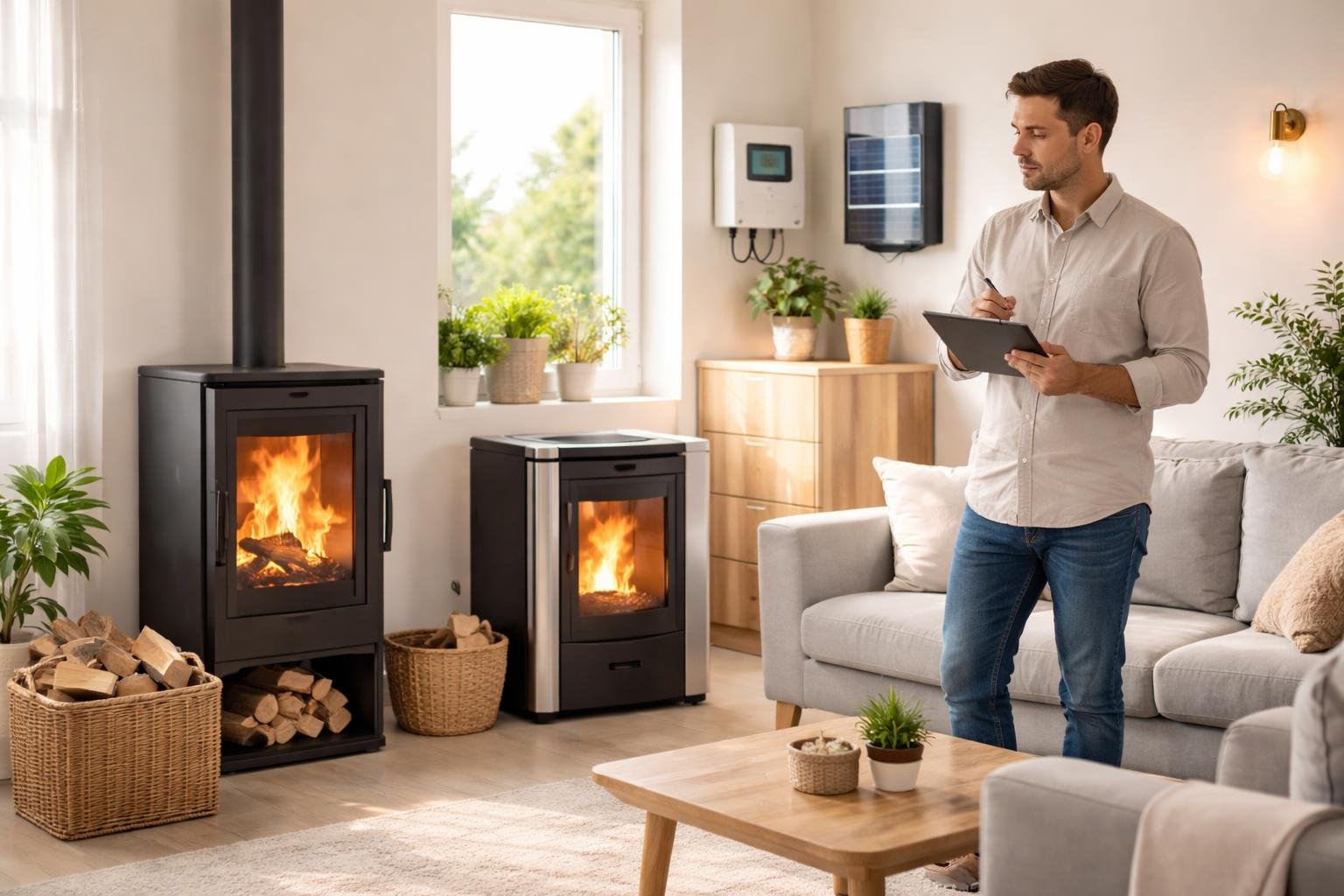
Heating costs vary widely based on upfront investment, fuel accessibility, and your local climate. Understanding how initial expenses compare to ongoing operational costs helps you choose the most practical system for your situation.
Initial Investment vs. Long-Term Costs
Wood stoves typically cost between $800 and $3,000 for the unit itself, plus another $1,500 to $3,000 for proper installation and chimney work. If you can harvest your own firewood, your annual fuel costs drop to nearly zero, making this one of the cheapest long-term heating solutions.
Propane systems require less upfront investment, usually $300 to $1,500 for a quality heater. However, propane refills add up quickly at $2.50 to $4.00 per gallon, and you might burn through 500 to 1,000 gallons each winter depending on your cabin size.
Oil boilers cost more initially at $4,000 to $8,000 installed but provide consistent heat distribution throughout larger homes. Fuel oil runs about $3.50 to $5.00 per gallon, and annual maintenance adds another $150 to $300.
Solar heating systems represent the highest upfront cost at $5,000 to $15,000 for passive solar installations or thermal collectors. After installation, your fuel is free, though you’ll likely need backup heating during low-sun winter months.
Hybrid Systems and Backup Heating Options
Combining multiple off-grid heating systems gives you flexibility and reliability. A wood stove as your primary heat source paired with a propane heater for backup creates redundancy when you’re away or don’t want to manage a fire.
Many people run passive solar during shoulder seasons and switch to wood or propane when temperatures drop. This approach can reduce your primary fuel consumption by 20% to 30% in fall and spring.
Common hybrid combinations:
- Wood stove + propane heater
- Solar thermal + pellet stove
- Heat pump + wood backup
- Oil boiler + electric space heaters
You need backup heating even with reliable primary systems. Equipment failures happen, and having a secondary option prevents frozen pipes and dangerous cold snaps.
Regional Factors, Climate, and Fuel Supply
Your location dramatically impacts which heating costs make sense. In heavily forested areas, wood becomes the obvious choice since fuel is abundant and often free.
Desert regions favor propane or solar since wood is scarce and expensive. Cold climates like Maine or Montana demand high-BTU systems that can handle sustained freezing temperatures.
A small propane heater won’t cut it when you’re facing weeks of subzero weather. Fuel accessibility matters more than cost per BTU in remote locations.
If you need to haul propane tanks 50 miles each refill, even “cheap” propane becomes expensive fast. Similarly, oil boilers only make sense if you have reliable delivery access.
High-elevation cabins face additional challenges with propane systems, which lose efficiency in thin air. You’ll also burn more fuel at 8,000 feet than at sea level due to heat loss and lower oxygen levels affecting combustion.
Frequently Asked Questions
Off-grid heating choices depend on your location, budget, and available fuel sources. Wood stoves offer the lowest ongoing costs if you have timber access, while propane provides convenience at higher fuel expenses.
What’s the most efficient heating system for off-grid living?
Wood stoves rank as the most efficient option for true off-grid heating when you factor in fuel independence and long-term costs. Modern EPA-certified wood stoves can heat 800-2,000 square feet depending on your insulation and climate zone.
Pellet stoves offer better automation but need electricity to run their auger motors and fans. You’ll use about 150 watts during operation, which means you need a solar system with battery backup to keep it running.
Rocket mass heaters provide exceptional efficiency by using less wood than traditional stoves. They burn small sticks and branches that would normally go to waste, making them ideal if you’re willing to do DIY installation.
How much does it typically cost to set up and maintain a geothermal heating system at home?
Geothermal systems aren’t practical for most off-grid situations because they require significant electricity to run heat pumps. The ground loop installation alone costs $10,000-30,000 depending on your property size and soil conditions.
You’ll also need 3,000-5,000 watts of continuous power to operate the heat pump. That means a large solar array with substantial battery storage, pushing your total system cost to $40,000-60,000 or more.
Annual maintenance runs $150-300 for filter changes and system checks. But the real issue is that without grid power or a massive solar setup, your geothermal system won’t work when you need it most.
What are the real upsides and downsides to using a geothermal heat pump?
Geothermal heat pumps deliver 3-4 units of heat for every unit of electricity consumed, making them highly efficient when power is available. They work in any climate and provide both heating and cooling from one system.
The underground loop lasts 50+ years with minimal degradation. You won’t deal with fuel deliveries, wood processing, or combustion byproducts in your living space.
But geothermal systems depend entirely on electricity. Without power, you have zero heat.
The high upfront costs make them impractical unless you already have reliable grid power or an extensive solar setup. Ground loops require significant land area for horizontal installation or expensive drilling for vertical loops.
Many off-grid properties lack the space or soil conditions needed for proper installation.
Can you break down the costs involved in heating and cooling a home with geothermal energy?
Installation costs break down into several major components. Ground loop installation runs $8,000-20,000 for horizontal trenching or $15,000-30,000 for vertical drilling depending on your property.
The heat pump unit itself costs $5,000-8,000 for equipment plus $2,000-4,000 for professional installation. You’ll also need ductwork if your home doesn’t already have it, adding another $3,000-7,000.
Operating costs depend on your electricity source. With grid power at $0.12 per kilowatt-hour, expect $600-1,200 annually for heating and cooling a 1,500 square foot home.
Off-grid solar systems add $15,000-30,000 to support the heat pump’s power needs.
What are some common issues or drawbacks I might face with geothermal heating?
The biggest problem is total dependence on electricity. When your solar batteries drain during cloudy winter weeks, your heating stops completely.
You need backup heating to avoid freezing. Ground loops can develop leaks in the refrigerant lines, though this happens rarely.
Repairs require excavation and can cost $2,000-5,000 depending on leak location. Heat pumps struggle in extreme cold when you need heat most.
Once outdoor temperatures drop below 20°F, efficiency decreases and your backup heating kicks in more often. Improper loop sizing causes short cycling and reduced efficiency.
Too small and your system runs constantly. Too large and you waste money on unnecessary installation costs.
Are there cost-effective alternatives to geothermal systems for off-grid heating?
Wood stoves provide the most cost-effective off-grid heating with installation costs of $1,850-5,600 total. If you have timber access, your annual fuel cost drops to nearly zero after the initial investment.
Propane heaters cost less upfront at $200-1,200. They require ongoing fuel purchases of $600-1,500 yearly.
Propane heaters work well as backup heat or in locations where wood stoves aren’t practical.
Rocket mass heaters offer exceptional value for DIY builders at $300-1,500 in materials. They use 70-80% less wood than traditional stoves while providing radiant heat for 12-24 hours after the fire goes out.
Passive solar design costs $500-3,000 for retrofits. It provides free supplemental heat during sunny days.
Combined with a wood stove or propane heater, you can reduce fuel consumption by 20-40% in sunny climates.